This article was originally published on Franchise Times, a sister publication to Food On Demand.
How restaurants leverage data on guest behavior in their markets will help increase off-premises sales for their franchisees, said Abhinav Kapur, the co-founder and CEO of customer data platform Bikky.
He also warned that with overall customer sentiment down and sales for dine-in and many legacy quick-service restaurant brands falling in today’s inflationary environment, it is imperative brands use the data to double down on their loyalty programs—and they should not be afraid to give away food or merchandise to ensure continued growth.
“On average, 80 percent of guests don’t come back after the first visit and that’s across all channels; in-store, loyalty, whatever. And so, what’s interesting is someone else’s guest today could be your guests tomorrow,” Abhinav Kapur said.
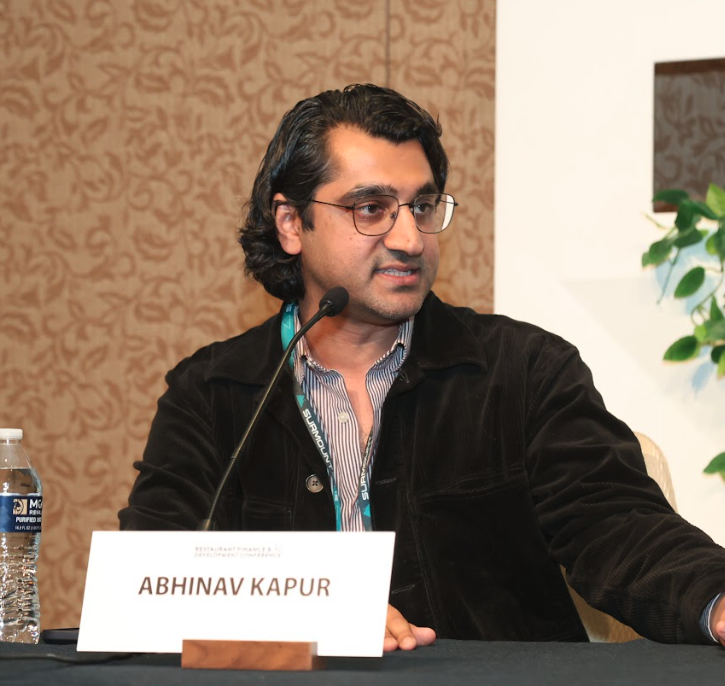
Abhinav Kapur, CEO and co-founder of Bikky.
Kapur was joined by Inspire Brands Chief Commercial and Restaurant Officer Dan Lynn and Dave’s Hot Chicken President and Chief Operating Officer Jim Bitticks on a panel, “Unlock Customer Insights with Data to Increase Off-Premises Sales and Profits,” at the Restaurant Finance & Development Conference in Las Vegas this week. Food On Demand Managing Editor Bernadette Heier moderated the panel.
The challenge for Roark Capital Group-backed Inspire Brands, which owns Arby’s, Buffalo Wild Wings, Sonic Drive-In, Jimmy John’s, Dunkin’ and Baskin-Robbins, is breaking down the consumer data across 20,000 domestic restaurants serving very different markets. “The thing that each restaurant needs to do next is very, very different,” Lynn said.
“We mentioned deaveraging” the data, “looking into the individual customer data, so now we can see when we go out with a value offering what happens to that individual customer and which customers do we change frequency on,” Lynn said. “Are we just taking our high-value customers and having them trade down, or are we re-engaging our customers who are lapsed, moving them back? And that’s normally what you’re trying to do in a lot of these cases.”

Bernadette Heier, Managing Editor of Food On Demand, moderated the panel.
Bitticks and Lynn said robust consumer data analysis has provided their respective companies guidance for scheduling limited-time offers and has served as an impetus to enhance their loyalty programs.
Bitticks shared the story of adding a cauliflower sandwich to the Dave’s Hot Chicken menu as a meatless option. The company, which branded the promotion as “Dave’s NOT Chicken,” brought it back early this year to its 300-plus North American stores. The company initially launched the items in 2024 and brought them back due to popular demand, even extending the promotion for a period.
“We were testing it and testing a couple different markets and what we found was that 60 percent of the people that were based on chicken were first-time guests and something like 60 percent of those people were women, which is different than the usual 40 percent women-60 percent men,” Bitticks said. “We also saw that when people were ordering cauliflower they were also ordering several other things. The check size was larger on cauliflower, so it implied that it’s like somebody coming with others that still eat chicken.”
Bitticks credited his 17-year-old son for helping convince him to pause the rollout of their new app until first overhauling the app-enabled loyalty program to move from a points system to a four-tier member model that rewards repeat customers with food deals.
“I did a first pass of the test app with him and he goes, how do I get my free stuff? I told him we’re not going to do that, that’s not how this works. I thought it was interesting because he’s a fairly affluent teenager,” he said.
Bitticks said Dave’s Hot Chicken “went back to the drawing board” so that its new loyalty program will be structured slightly different. “Bronze was like a free side item. Silver was a free premium side item and then the third tier was the gold, which was a free combo meal,” he said. Platinum members will be eligible to redeem their points for free merchandise.
The panelists all recommended that restaurants take advantage of artificial intelligence to help analyze their sales and consumer data, mainly as a way to cut expenses and save time.
But the most repeated theme from the data panel was restaurants need to to take advantage of their consumer data to help increase sales and to better stay ahead of the shifting buying trends of their restaurant guest.
“You want to move as many of your new guests as possible to the top of the funnel. How do I get new guests in the door and how do I get someone from their first visit to their second and third visit? There’s a 10 percent chance someone comes back after their initial visit. After visit two, it jumps to 40 percent and after visit three you go to 50 percent then 60 percent, then it sort of plateaus at 70 percent,” Kapur said.
The Restaurant Finance & Development Conference, presented by the Restaurant Finance Monitor, Franchise Times and Food On Demand, wrapped up on November 12 at the Bellagio in Las Vegas.