The gig economy is a constantly evolving marketplace, with a myriad of factors ultimately impacting the prices consumers pay and the earnings workers receive.
Gridwise, a delivery driver and rideshare assistant app, released its third Annual Gig Mobility Report, revealing insights into pricing, driver earnings, tips, type mixes for delivery platforms and utilization trends across major U.S. rideshare and delivery platforms, among other details. 
The following is an overview of the report and the many trends shaping the food delivery industry.
Delivery driver hours rise dramatically while pay metrics stagnate
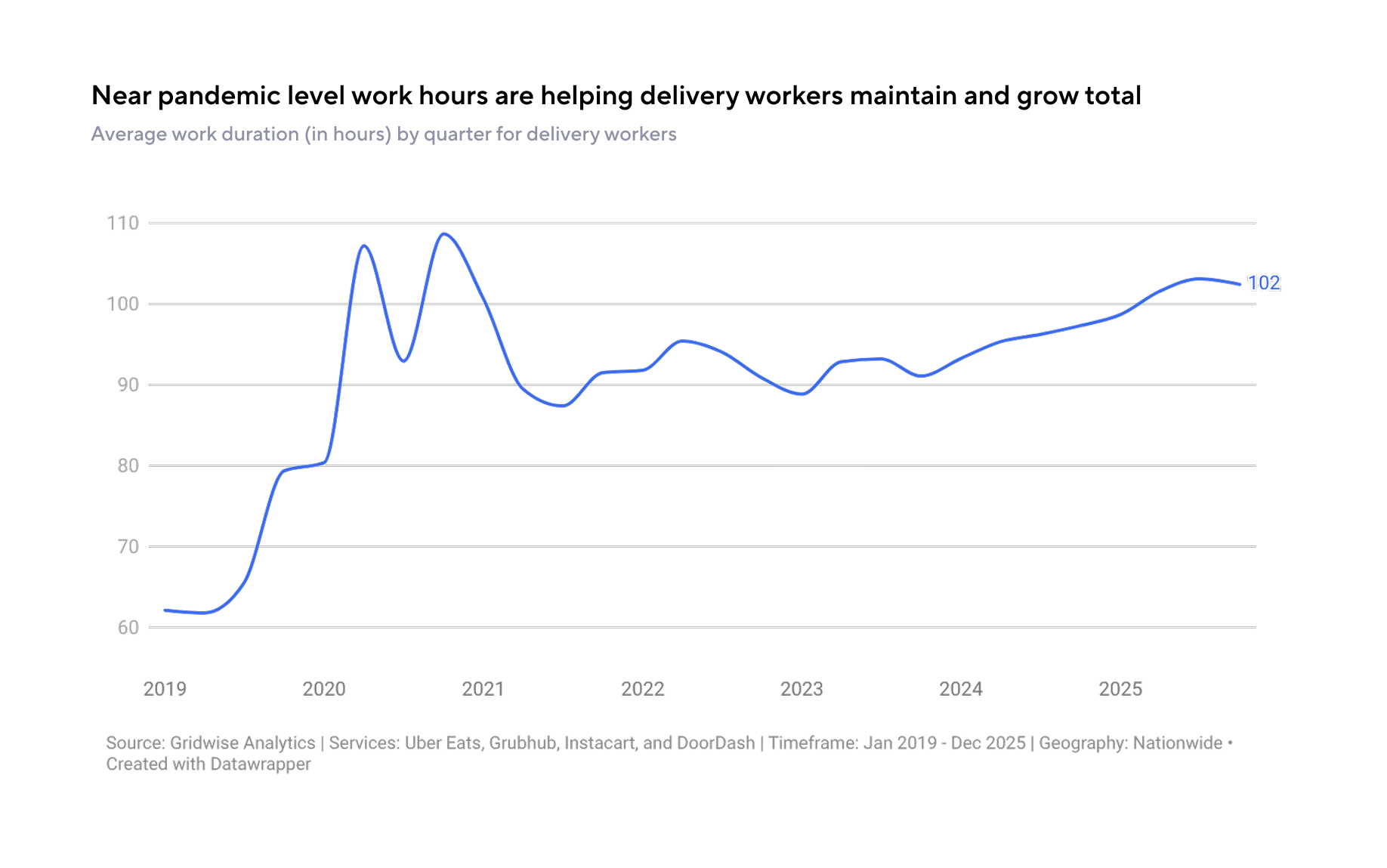 The 2026 Annual Gig Mobility Report revealed a significant change in work behavior among delivery laborers in the gig economy, with couriers packing in significantly more hours than in the last few years despite decreases in hourly and per-order earnings during the same period.
The amount of time couriers are putting into their work is nearing levels only previously seen in the early years of the pandemic. By late 2025, average quarterly work hours ticked in the triple digits, with the rise in time spent on the job supporting higher total earnings for the sector.
Average quarterly work hours jumped more than 17 percent between Q3 2012 and late 2025, rising from around 87 hours to more than 100. This accounts for a 5.2 percent increase from Q4 2024 to the final quarter of last year.
Meanwhile, earnings per delivery as of late last year increased slightly year over year, up 1.3 percent to $9.39 in Q4 2025, compared to 12 cents less at the end of 2024. The 2025 figure still falls dramatically short of the $12.55 per-order pay seen in mid-2020.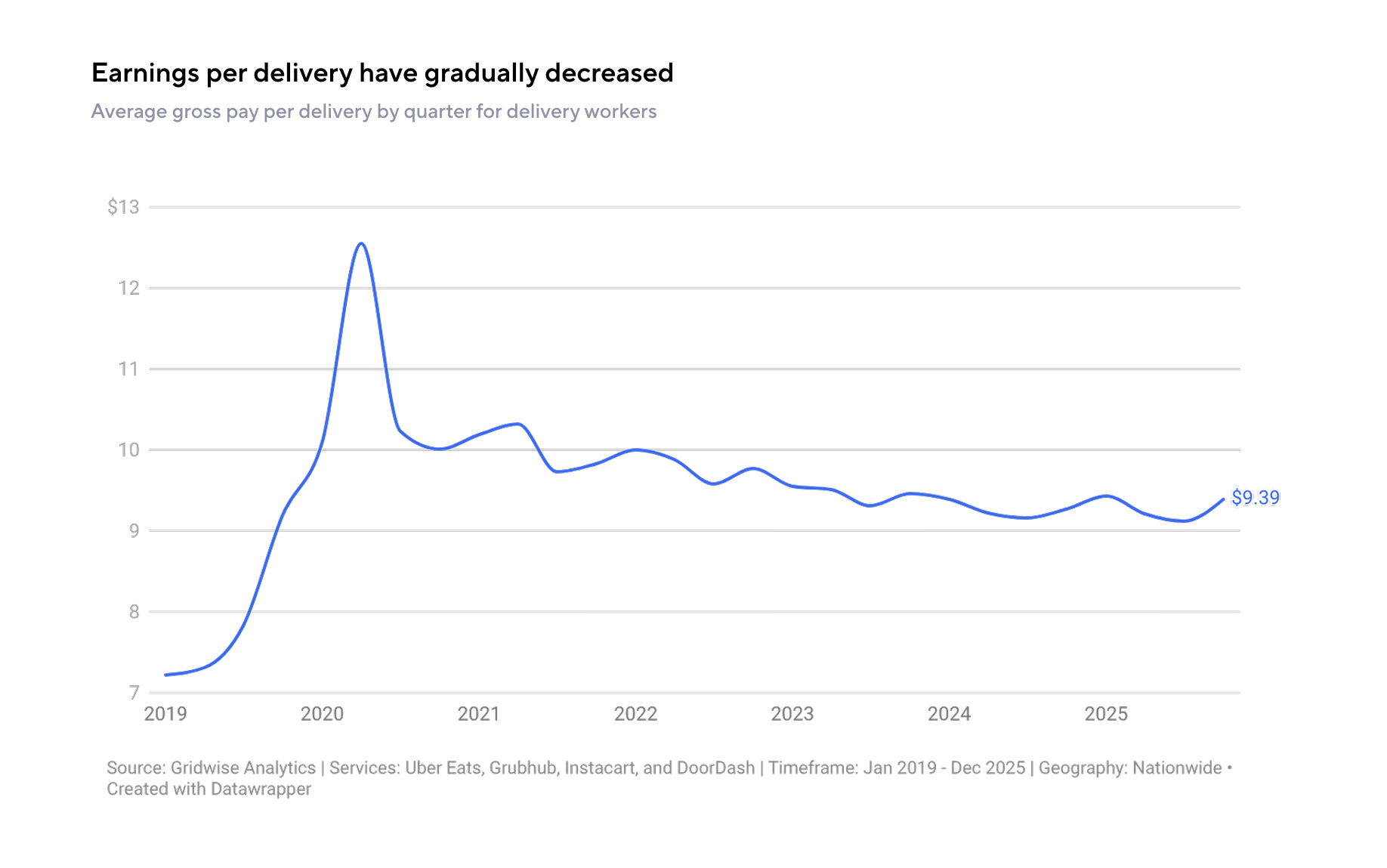
Similarly, hourly delivery earnings rose 3.2 percent between Q4 2024 and Q4 2025, reaching $14.66 late last year. That figure is well above the 2019 hourly rate of about $10 but falls short of the nearly $16 per-hour peak take-home pay seen during the strongest pandemic-era quarters in 2022.
One of the factors most impacting hourly earnings, according to Gridwise CEO Ryan Green, is a steady decline in tip pay since that metric rose in 2021 and 2022. Stagnation across other aspects of delivery pay, along with the decline in tipping, resulted in a relatively moderate rise in pay-per-trip and pay-per-order rates.
“As we look forward into 2026, the question is: Are we going to see them (3PD platforms) change the mix of pay components, or pull different levers any differently — as we think about the fixed cost as it relates to incentives and the bonus pay that they provide — or the base rates?” Green said. 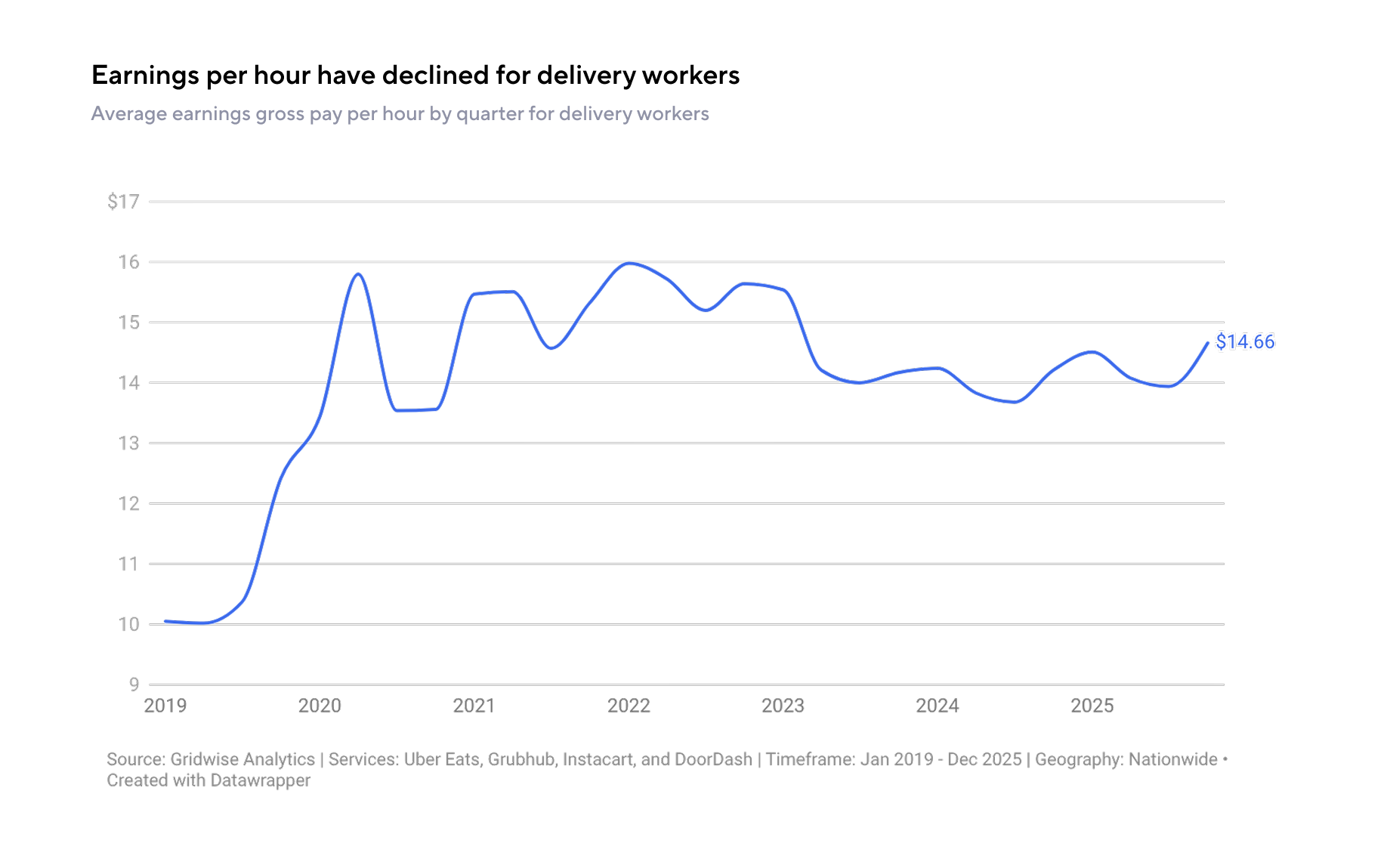
Delivery pay recovering after yearslong slump
Delivery drivers are seeing average quarterly earnings approach pandemic-era all-time highs of about $1,600 for the first time since that figure started to slump in late 2021. 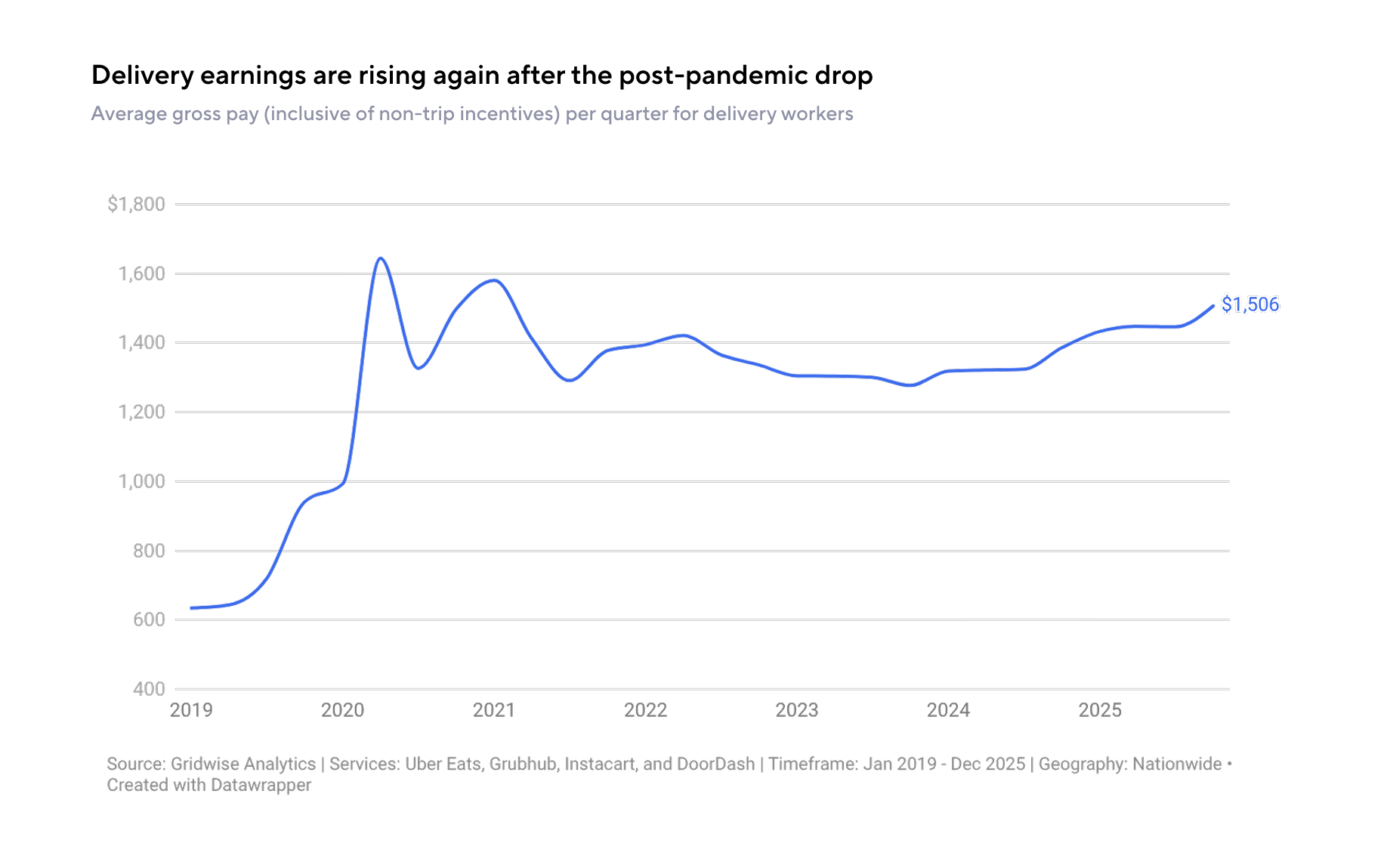
The average quarterly delivery earnings surpassed $1,506 in Q4 2025, up 8.7 percent year-on-year from about $1,386 at the end of 2024.
Green credited this increase to 3PD platforms expanding into new categories and to higher batching rates, which increased available revenue.
“I think it’s really a function of the category expansion, of why we’re seeing that take place,” Green said of the rising quarterly earnings. “If you look back at the pandemic, most of the third-party marketplaces that existed were all providing very verticalized solutions. … Now they’re becoming inclusive of all kinds of categories: convenience, pharmacy, retail and grocery, etc.”
Has gratuity reached its “tipping point”
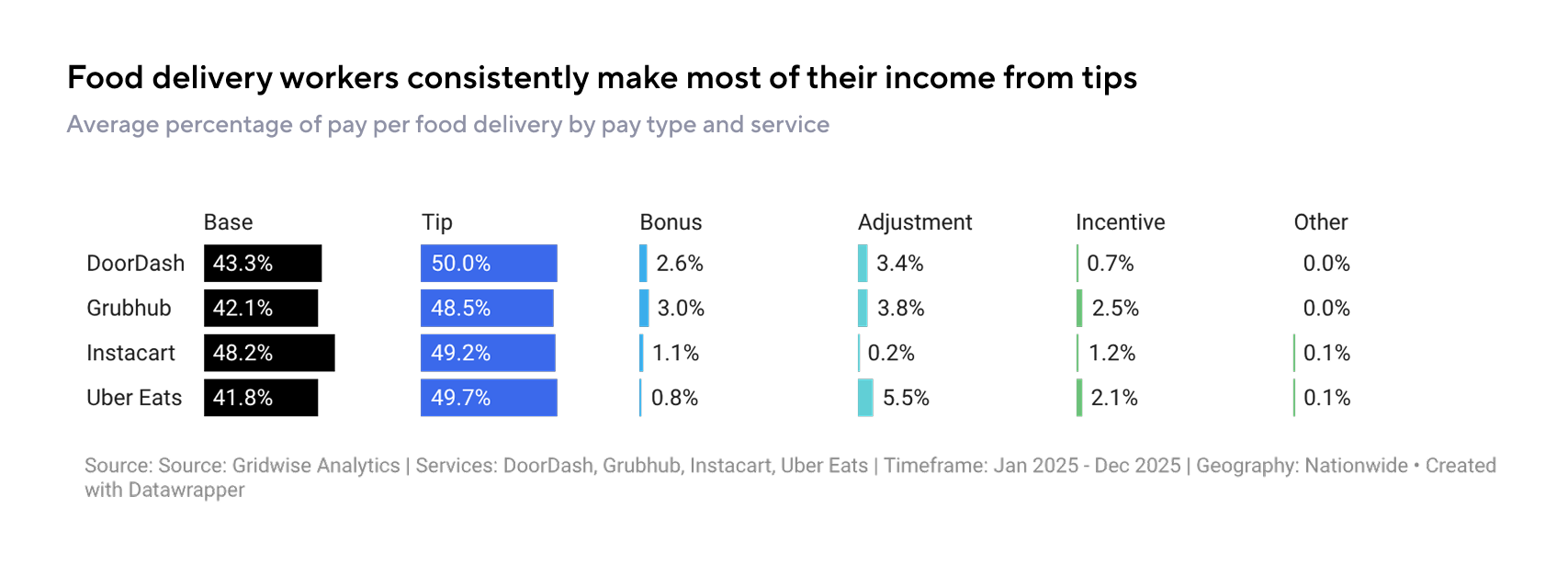 Tipping accounts for the largest share of per-delivery pay for couriers in the gig economy, but consumers have been more conservative with their gratuities over the last couple of years than during the peak of the pandemic.
Using data from Uber Eats. Grubhub, Instacart and DoorDash, Gridwise Analytics found average delivery tips decreased slightly year-over-year, down .7 percent to $4.19 in late 2025 compared to Q4 2024. For those same platforms, gratuity accounted for between 49.7 percent and 50 percent of total per-delivery income.
“It’s probably us reaching a tipping point, no play on words here, on how much a consumer or customer is willing to tip,” Green said. … “Maybe we have reached the max marginal rate of return we can get on tipping. So, what’s the next lever to really drive anything that can allow us to increase earnings that allows the companies to increase revenue and still have some healthy margin on take their or platform piece?”
Green said the user experience within the 3PD apps is the single largest factor impacting tipping behavior. Default percentage suggestions, the timing of tip requests and other factors all affect broader gratuity trends.
“They’re testing a ton in fixed tip rates or percentages,” Green said of major 3PD platforms. “We’ve seen those tipping percentages increase a lot more on some markets relative to others.”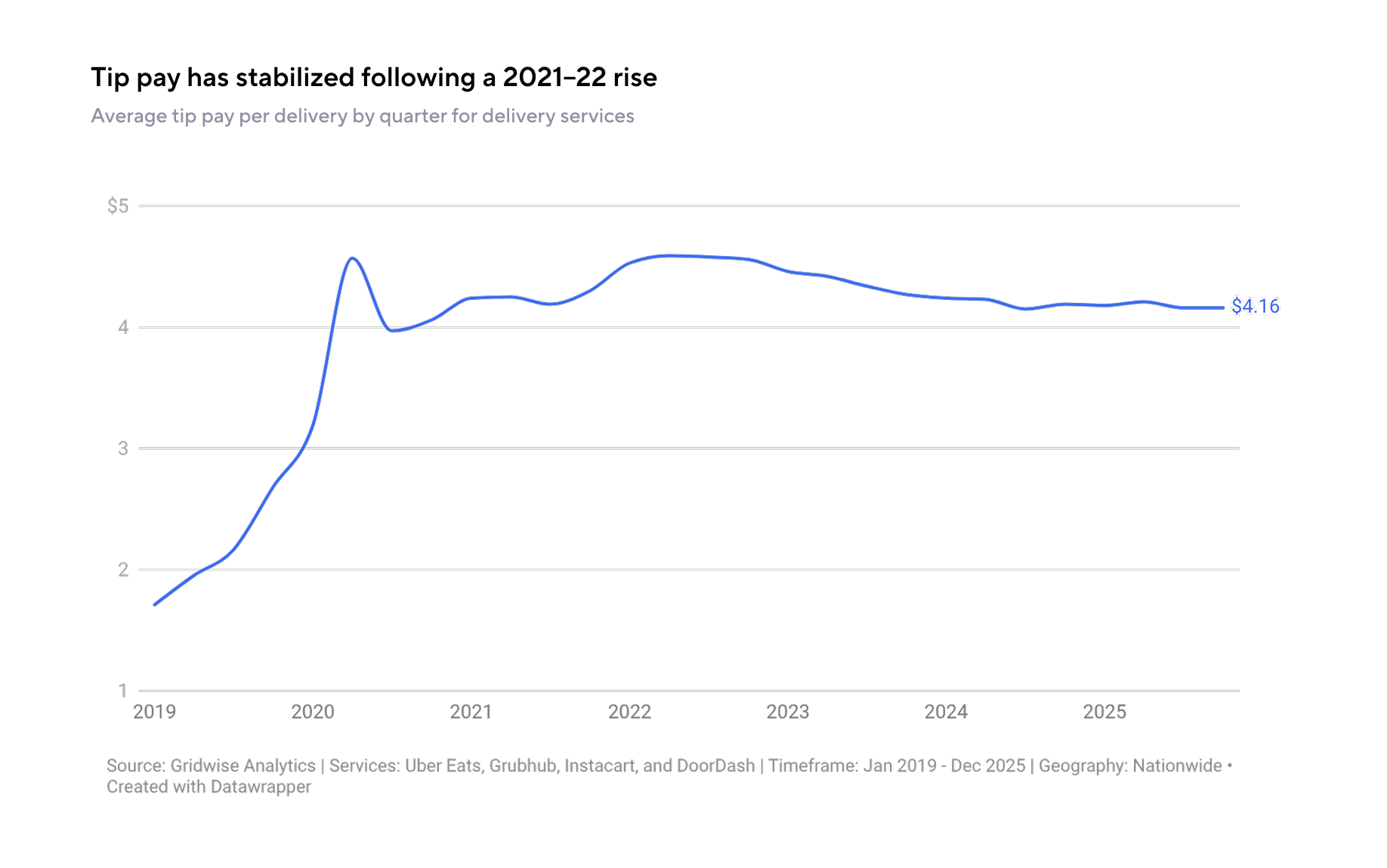
The report concluded that another factor impacting tips is the minimum pay laws put into effect by local governments. Seattle, for instance, saw delivery tip frequency fall from 92.8 percent in December 2023 to 44.1 percent in February 2024 after such legislation was enacted. New York City similarly saw a 40.3 percent decrease in tip incidents between November 2023 and January 2024 after such laws were passed.
Local officials, including NYC Department of Consumer and Worker Protection Commissioner Samuel A.A. Levine, previously claimed the dramatically suppressed tips were a result of “design tricks” from the 3PD platforms rather than the minimum pay laws.
Interestingly, food delivery platforms saw tips much higher than ridesharing apps, which Green suggested may be due to the widespread and long-held association of tipping with food-related services.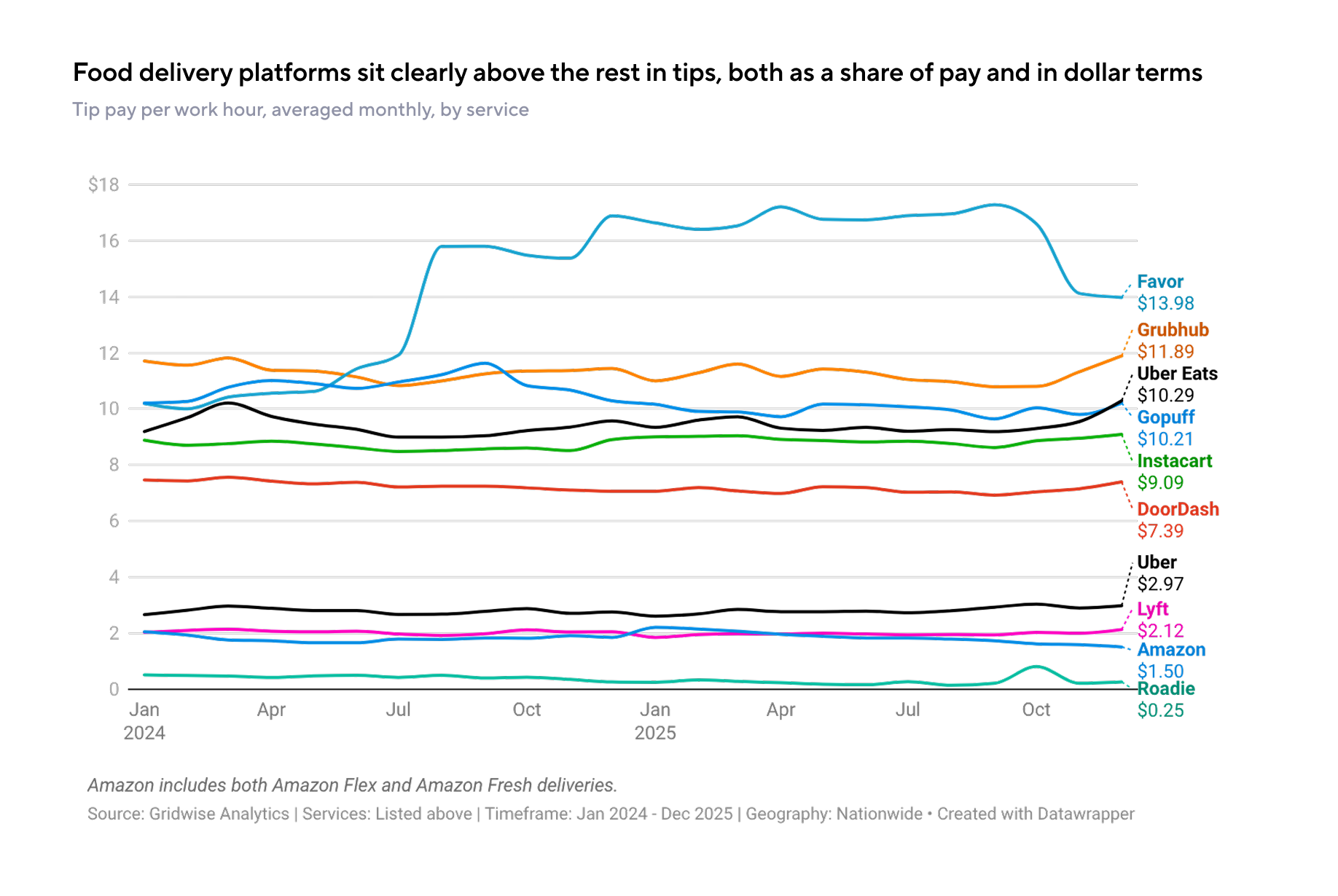
Utilization rates see slight climb after record lows
Although gig-economy couriers are putting in more hours than in previous years, the time spent waiting between orders is only starting to increase slightly after a stark trend of decreased utilization began in 2020. 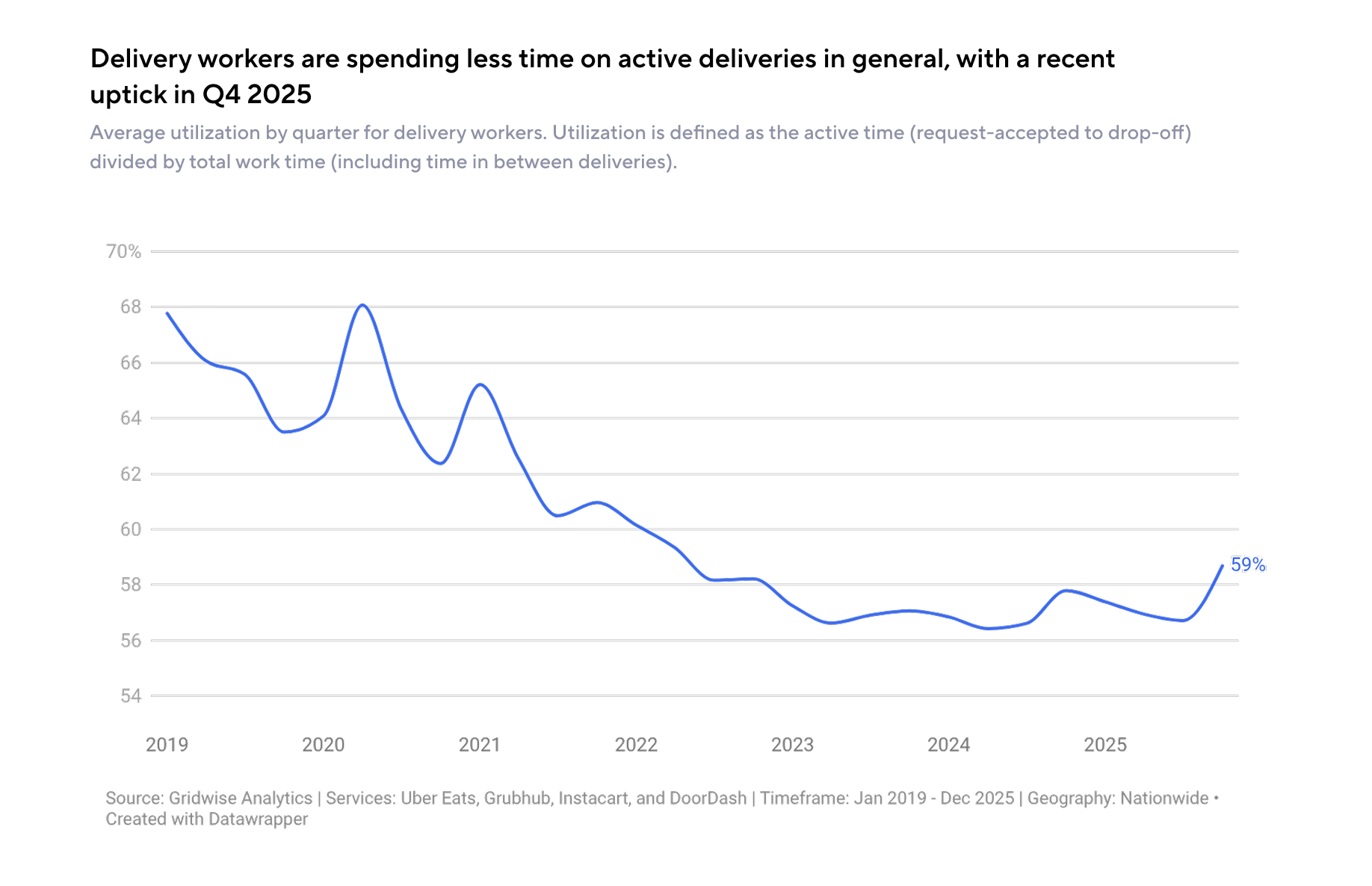
The amount of time delivery workers spent on active deliveries in Q4 2025 was 58.69 percent, up about 1.5 percent from the same time in 2024. This figure remains far short of utilization highs of about 68 percent in 2019 and 2020.
Green said the relatively low time spent delivering was a factor of supply dynamics in the market, which has been oversupplied with labor since about 2021.
“That was (about) that time when you started to see inflation start to take off. You saw interest rates rise,” Green said. “You saw unemployment — going into 2022 — starting to rise, and a lot of layoffs happening as well, and the cost of living has just continued to rise substantially globally. And as that has taken place, more and more people have flocked to gig work as a way to augment their existing income to help them better meet their expense needs, etc.”
3PDs compete for the holidays
Just as holidays and nationwide events impact people’s day-to-day lives, those days and the surrounding dates also drastically affect consumer behavior in the 3PD market. 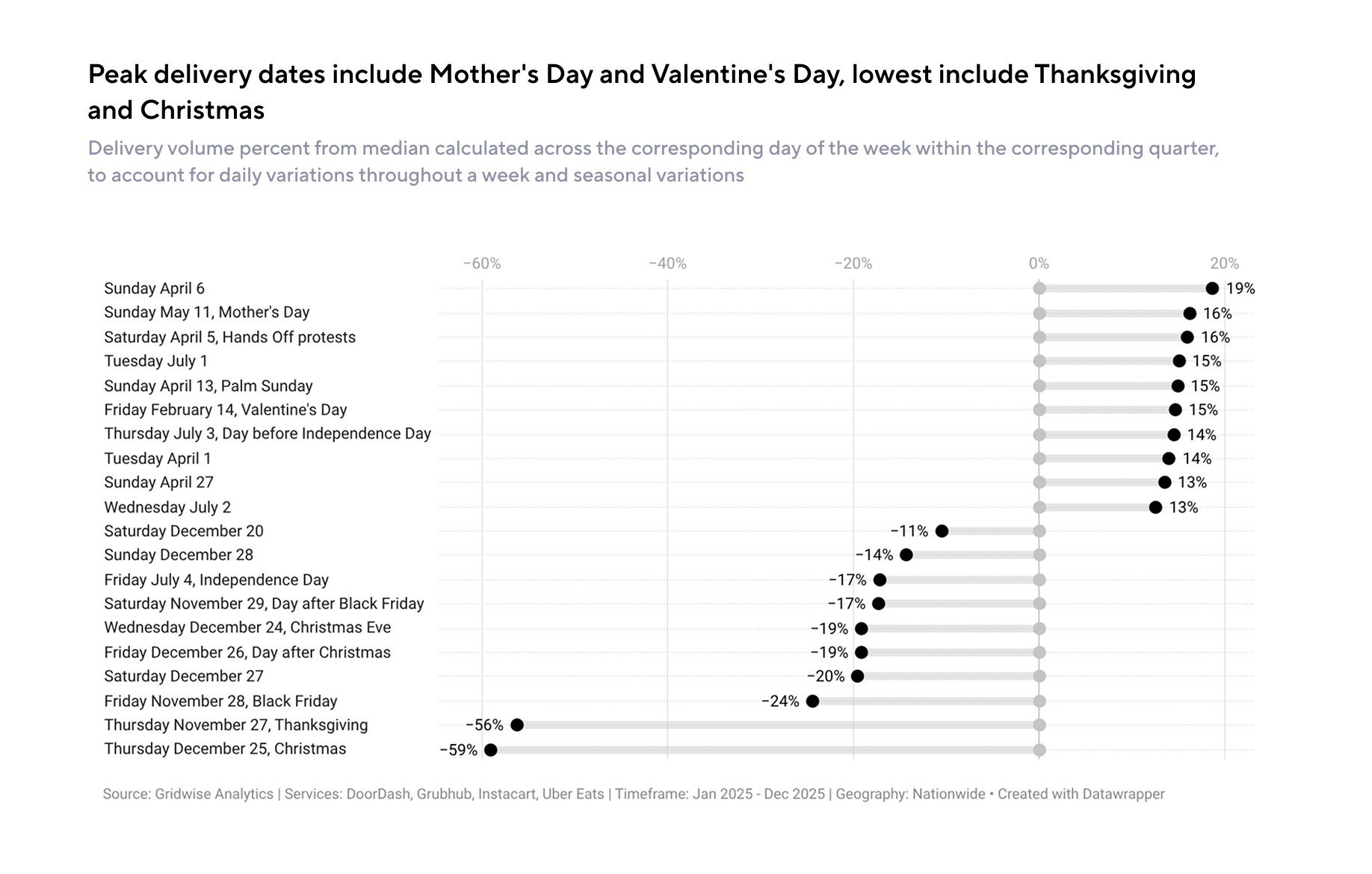
Gridwise Analytics found delivery volume increase sharply for 3PD platforms on holidays such as Mother’s Day and Valentine’s Day, with volumes 16 and 15 percent above average, respectively. Similarly, events like the Hands Off protests last April correlated with a volume up by about 15 percent. On the other hand, Thanksgiving Day and Christmas both saw delivery volumes down more than 55 percent.
“As we think about where competition heats up a lot and where there’s ability to grab share, owning holidays (and) being the go-to platform for Mother’s Day, Valentine’s Day, Thanksgiving or other holidays where food or delivery of some kind of good, is pretty critical to people at that time,” Green said.
Delivery beyond food
Delivery platforms that traditionally focused on food delivery expanded their presence into retail and grocery last year, according to Gridwise Analytics data from Grubhub, Uber Eats and DoorDash. 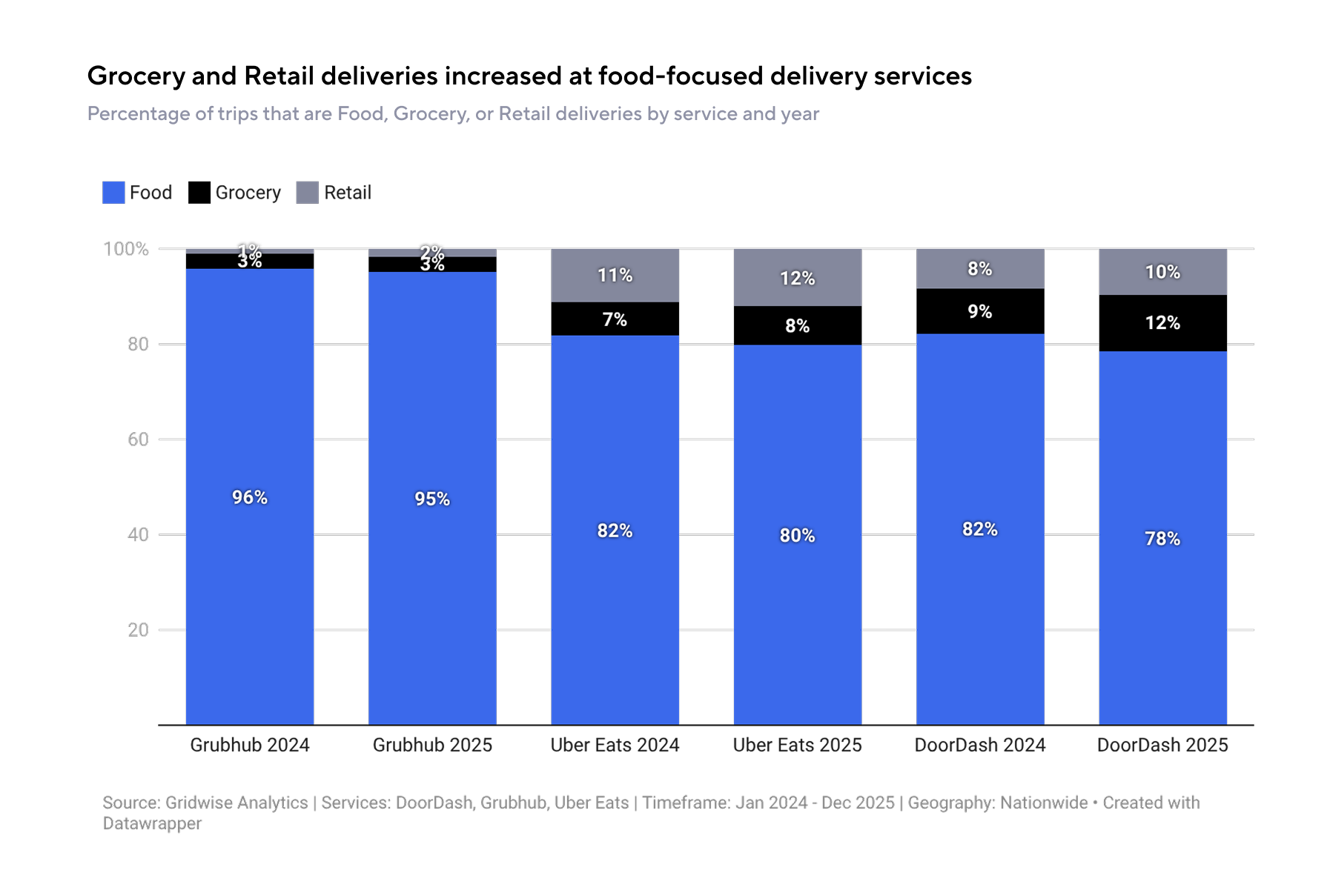
Of the three mentioned platforms, DoorDash had the highest growth in delivery mix related to retail and grocery orders, up from 16 percent in 2024 to 22 percent in 2025. Uber Eats grew its non-food delivery mix by 2 percent, reaching 20 percent in 2025. Grubhub remained the most food delivery-oriented, with 95 percent coming from food orders, down 1 percent from 2024.
Green said other categories of non-food delivery are displaying potential for the rideshare and delivery platforms, including peer-to-peer delivery and other miscellaneous tasks that the gig workforce can complete outside of delivery.
“I think an interesting one that we’re starting to see some early data on right now is around DoorDash partnering with Waymo (self-driving cars), sending their Dashers to go close Waymo doors on the vehicle, or things like that,” Green said. “We started to see early data of that coming in from like Atlanta, where they’ve started that partnership, and seeing like earnings data come in for Dashers who are completing that.”