When it comes to drive-thru innovation, “the magic happens at the window.”
That’s according to Patrick Shaheen, vice president of operations for Ballard Brands, whose coffee concept PJ’s Coffee of New Orleans is redefining the modern drive-thru experience.
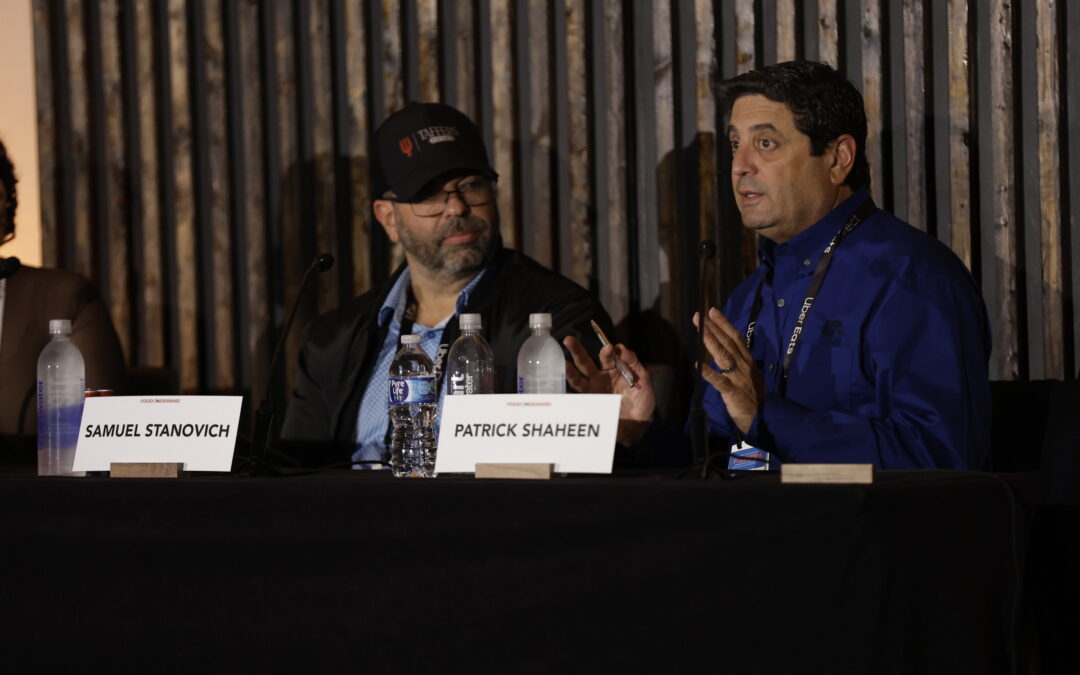
Shaheen, along with Craveworthy Brands Senior Vice President Samuel Stanovich, spoke on a panel about the modern drive-thru May 6 at the 2026 Food On Demand Conference in Dallas. Lauren Selman, vice president of operations for the International Food and Beverage Technology Association, moderated the discussion.
PJ’s has taken a hybrid approach to its store format in recent years, finding success in a hybrid dine-in café and drive-thru model. The company previously estimated its hybrid locations generate between 30 to 40 percent higher revenue than café-only units.
Shaheen said about 80 percent of PJ’s units have a drive-thru component.
“We are a drive-thru company at PJ’s Coffee,” he said. “Everything we talk about is drive-thru, and we do everything we can to make sure that drive-thru is as efficient and as fast and as accurate as possible.”
At Gregorys Coffee and other drive-thru-heavy concepts across Craveworthy’s portfolio, Stanovich said consumers’ drive-thru expectations can shift based on what the line looks like. When it comes to speed, guests tend to show more patience and forgiveness in a line of cars versus being the only car in a drive-thru.
What doesn’t change is the role accuracy plays in the drive-thru. If anything, it becomes even more important.
“Consumers are giving us grace in the drive-thru, so it doesn’t need to be fast—but it needs to be accurate,” Stanovich said. “If we’re sitting and listening to what the consumers say, it should be accurate, it should be hot and it should be right in the bag. I need to make sure all those things are done properly and use every tool available to make sure that’s done right.”
Shaheen attested to this focus, especially as Craveworthy and Ballard play in the coffee segment, where its consumers perhaps desire accuracy more than others across the quick-service category.
“Accuracy is paramount in our concept,” said Shaheen, who noted PJ’s focus on robust training to ensure orders are made right before handed through the window.
Technology innovation is on the table and only continues to evolve in the realm of artificial intelligence, heat mapping on digital menu boards, and license plate and facial recognition. Stanovich and Shaheen agreed on the potential to eventually greet loyalty customers by name and pull up their order history and habits upon seeing a car pull up in the drive-thru.
Stanovich said the cost and value of these tools—and in turn, the cost impact on menu items—should be considered for each brand before adoption.
Technology sans the right people and training processes can only do so much to enhance the drive-thru experience. What still proves essential is implementing with intention and harboring an authentic, human-to-human experience.
Stanovich noted a jarring example: hearing the change between an initial prerecorded greeting voice in the drive-thru followed by a different person talking seconds later.
He said having the clocked-in employee record the greeting for their shift, resulting in a smoother transition from prerecorded to live-time voice, is a simple way to blend technology with a human touch for stronger consumer interactions.
“People underestimate the value of human interaction. There are people who don’t want to have that face-to-face, but there are certainly brands that are doing incredibly well by simply using their staff to give you that experience at the drive-thru,” Selman added. “I think we look at it sometimes as tech people and say ‘No, it needs to have more tech, more tech, more tech.’ But sometimes, that’s not always the answer.”
The 2026 Food on Demand Conference wrapped up Wednesday, May 7, at the Renaissance Addison Dallas Hotel.