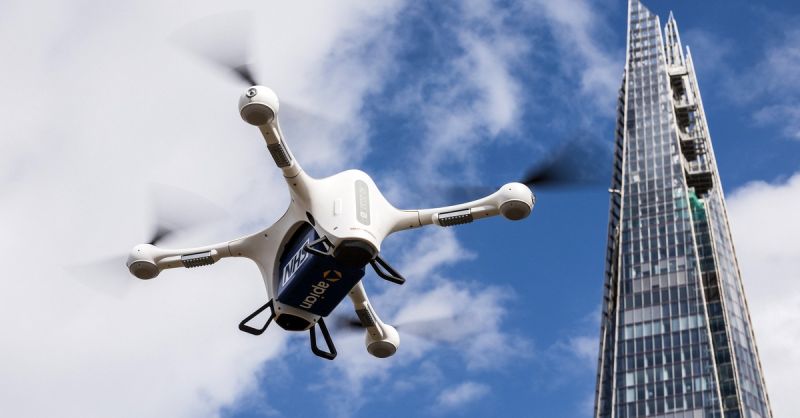
After nearly 15 years of developing aircraft and delivery infrastructure, California-based drone delivery platform Matternet is finally ready to take off.
That’s the assessment of CEO Andreas Raptopoulos, who says the company is positioned to scale significantly following a string of strategic partnerships, approval to operate in the U.K. and a reverse merger that took the company public. Those moves all come from the first half of 2026 — a year he calls “the inflection year for drone delivery in the United States.”

Andreas Raptopoulos, founder and CEO of Matternet
With a $33 million private funding round announced May 28, Matternet claimed its spot as the first publicly reporting, pure-play drone delivery company. The company completed a reverse merger with Los Altos Ventures Corp. alongside the financing, which was renamed Matternet Inc.
Matternet earmarked those funds to launch its next-generation drone platform and expand operations across the food, retail and healthcare delivery sectors.
“People underestimate how much this space is going to scale over the next three to four years,” Raptopoulos said. “We are talking about 1,000X delivery in drone delivery in the United States over the next four to five years. This is going to revolutionize how we get access to goods.”
Regarding its U.S. operations, Matternet started business-to-business healthcare delivery operations in 2019 and expanded into business-to-consumer drone delivery in Silicon Valley in 2024. The company’s partnerships include UPS for healthcare logistics and Dave’s Hot Chicken in the restaurant space.
Matternet’s strategic partnerships
In mid-May, Matternet announced a partnership with fellow San Francisco Bay-area tech company Amprius Technologies, which specializes in advanced lithium-ion battery technology.
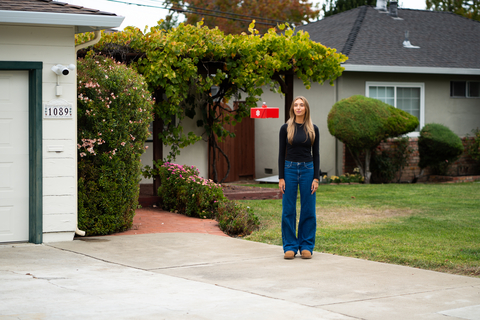
Matternet announced a partnership with Amprius Technologies, which specializes in advanced lithium-ion battery technology, on May 19.
Amprius manufactures silicon anode cells, which deliver up to twice the energy density of conventional graphite-based batteries, according to a May 19 release. Raptopoulos said that capability provides a critical advantage for Matternet’s drone performance, as battery weight directly impacts delivery range and carrying capacity.
“Our current system is able to carry payloads of up to 4.5 pounds, in distances of up to five miles when you have a hub model,” Raptopoulos said of Matternet’s M2 aircraft. “In our next generation system, we are more than doubling the weight to 11 pounds and the service radius will become 10 miles. It allows us to really serve way more of the addressable market.”
Amprius cells are already deployed in Matternet’s M2 drones, but through the partnership, the companies aim to optimize cell selection, charge rates and cycling for the company’s next-generation aircraft. Amprius targets volume production readiness to meet Matternet’s expansion ambitions beginning early next year.
Matternet’s drones accept interchangeable batteries, which Raptopoulos said showcased its advantage when the rollout of Amprius cells did not require significant adjustments for the M2 fleet.
Raptopoulos said the increased carrying capacity opens the door for Matternet’s drones to satisfy family-sized food delivery orders. Additionally, the expanded range allows the company to rethink its delivery network designs to better serve operators’ needs.
“The vast majority of deliveries are within five miles, but when you have the capacity to go further, you can design your network again with a restaurant partner to serve customers,” he said.
Raptopoulos used Dave’s Hot Chicken as an example, demonstrating how that advantage could translate into real-world benefits for restaurants. If there are two locations in close proximity, with drones serving 5-mile radii during daytime hours, but one restaurant closes earlier, the delivery range could be increased for the store that stays open to satisfy deliveries from some guests who otherwise would be served by the closed location.
In mid-April, Matternet announced a partnership with another San Francisco-based company, SoftBank Robotics America, which also aimed at positioning the drone platform to compete in the autonomous aerial delivery space.
While Matternet’s current fleet is smaller than some competitors in the space, like Zipline, Raptopoulos said the partnership positions the company for growth with the aims to commercialize and deploy drone delivery solutions for enterprise customers, initially focusing on healthcare, then on commercial delivery. SoftBank Robotics America will manufacture, install and maintain Matternet’s ground systems.
“Let’s say we want to roll out drone delivery with a restaurant partner or a coffee shop chain, and we want to go to 1,000 locations in the course of two or three years,” Raptopoulos said, “SoftBank Robotics allows us to come to the table demonstrating that capability that we really have the muscle to scale.”
Raptopoulos described that ability to scale quickly as critical to meeting Matternet’s goal of 1 million daily deliveries by 2032, which would require an estimated 40,000 operating aircraft.
Expansion Strategy
Raptopoulos described Matternet as more customer-led than many competitors, resulting in two approaches he described as advantages over the next half-decade: an eager pursuit of regulatory certifications and a microhub infrastructure model where expansion follows merchants.
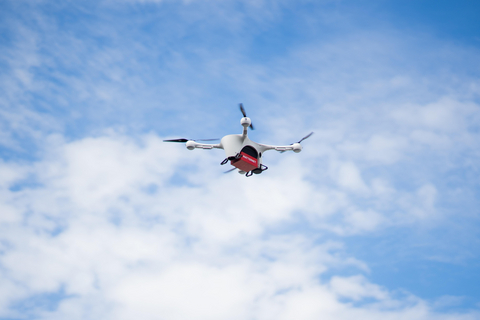
Matternet launched drone delivery operations in Central London for the U.K.’s National Health Service April 24, marking the company’s first operations in the country.
Matternet announced the launch of drone delivery operations for the U.K.’s National Health Service in Central London April 24, marking the company’s first services in the country and a significant step toward building a broader, city-wide medical drone network.
Raptopoulos described the process of obtaining approval for delivery by air between two of Central London’s busiest hospitals as an involved effort that required close coordination with the UK’s Civil Aviation Authority. Still, he said the endeavor proved relatively straightforward because of Matternet’s operational advancements; proven track record in Zurich, Switzerland; and existing authorization for aerial deliveries in Berlin, Germany.
For cases like London, Raptopoulos sees healthcare operations as the entry point into a market, demonstrating capabilities in the jurisdiction with relatively few high-impact deliveries. Eventually, he said, commercial cases could follow.
“After that (healthcare delivery) is to actually get that benefit to people’s homes, and you do this by delivering pharmacy and eventually getting food and retail,” Raptopoulos said. “We’re very excited about, you know, starting a place like London, because it opens up the whole space for us, not just healthcare, but eventually being able to do all these other use cases.”
Matternet’s regulatory strengths include its FAA type certification — which it received for its M2 model — and a production certificate allowing the manufacturing of systems in-house. The company’s approach to certification is critical to Matternet’s strategy to scale with enterprise partners, Raptopoulos said in an interview with Aviation Week.
Matternet’s microhub infrastructure describes the company’s drone storage, battery charging and package-loading station designed to fit in compact and convenient areas outside of partner locations.
“You can have one of those stations on the back of a Dave’s, or on the back of a CVS or Starbucks,” Raptopoulos said. “With some of our peers, they need to have centralized hubs in cities because they don’t have the capability to have aircraft at the merchant location. That means they need to have a city-by-city rollout strategy, whereas in Matternet’s case, we can actually follow a merchant.”
Following a pilot program last fall, Matternet plans to start rolling out services at Dave’s Hot Chicken in the coming months, Raptopoulos said, starting with one unit and scaling from there.
As regulatory hurdles continue to fall and consumers grow increasingly comfortable with autonomous delivery drones, Matternet’s ability to outmaneuver competitors and secure partnerships in the latter half of 2026 appears critical to the company’s broader ambitions to scale.
“They say that the future is here, but it’s just not equally distributed,” Raptopoulos said. “We’re going to see that future of drone delivery being more equally distributed in the next few years, and it’s very exciting because people will feel this is actually here, that the technology is figured out — simple, safe and quiet. That’s really the key thing that’s going to shift in people’s perception; this thing will not feel like the future anymore, it will feel like the present.”