It used to be that operators who wanted to make accurate forecasts would study four-week financials like a freshman cramming for a final and hope for the best. Bo Davis remembers this well.

Bo Davis, CEO and co-founder of MarginEdge
“If you’re looking at a financial statement that takes weeks to put together, you’re always looking in the rear-view mirror,” said the CEO and co-founder of restaurant-management platform MarginEdge and founder of sushi chain Wasabi in an interview. “It’s a brutal way to manage a business.”
Especially when you’re offering fresh fish. If you guess wrong, you end up throwing out your inventory every night. Davis managed this stress at Wasabi for many years, until he pivoted to launching MarginEdge in 2015.
“Back then we didn’t have cloud-based POS systems,” he said. “But my background was in technology. We built tools to help us, which were the tools that we productized for MarginEdge. Then machine learning came along.”
To say machine learning has been a game-changer would be an insult to games and change. Davis knew it instantly. He calculated that it would profoundly impact the services MarginEdge provides restaurants and he needed to understand it. So he went back to school.
“I got a master’s degree in data science from Northwestern University in 2021,” he said.
Davis wants to keep the data-nerd stuff away from the 11,000 operators MarginEdge supports. He wants to keep their focus on one number: projected sales.
“We can tell an operator you are going to sell $7,000 that day,” he said.
It arrives at such accuracy by connecting its platform directly to the POS systems of clients.
“Once we do that we immediately ingest two years of data,” he said. “We feed that data into our ensemble models to come up with forecasts.”
MarginEdge’s ensemble models are a mixture of analytics and democracy.
“They are a series of machine-learning models that run simultaneously and separately,” he said. “They are all different mathematical sequences and you feed data to each of them and each of them comes up with a prediction. We have nine machine-learning models in this ensemble. Each of those models independently comes up with a prediction on how much food your restaurant will sell tomorrow and then they vote. We take the statistical analysis of the nine answers and find the ones that are correlating around the right solution. That’s the solution that’s presented to the client.”
To the client it will come across just as a number.
“We handle all the complexity so an operator can decide, Oh, I need to order more fish,” he said.
It would be tempting to assume that machine learning has turned forecasting completely on its head. Not exactly the case. Many of the old fundamentals are still in play.
“The typical method of forecasting is an algebraic equation that takes the change in last year’s sales to this year’s sales to get a delta multiplied by the next week of last year’s sales,” he said. “It’s basically your year-over-year trendline times the change over last year and the trailing. Algebraically it works. The problem is it doesn’t know if it’s going to snow.”
Machine learning can even take that into account. And more. Much more.
“We’ve injected jet fuel into the process where we were using diesel before,” he said.
Davis estimates that engineers who write code are 50 percent more productive than they used to be. MarginEdge has a new skip in its step with its own growth.
“Our trailing five-year growth rate is about 65 percent year over year,” he said.
Not that it’s standing pat.
“We’re spending 15 times as much today on R&D as we were five years ago,” he said.
There’s still an education piece for operators who don’t have a master’s degree in data science. But they perk up when Davis explains how it can help them not just with forecasting but ingredient analysis.
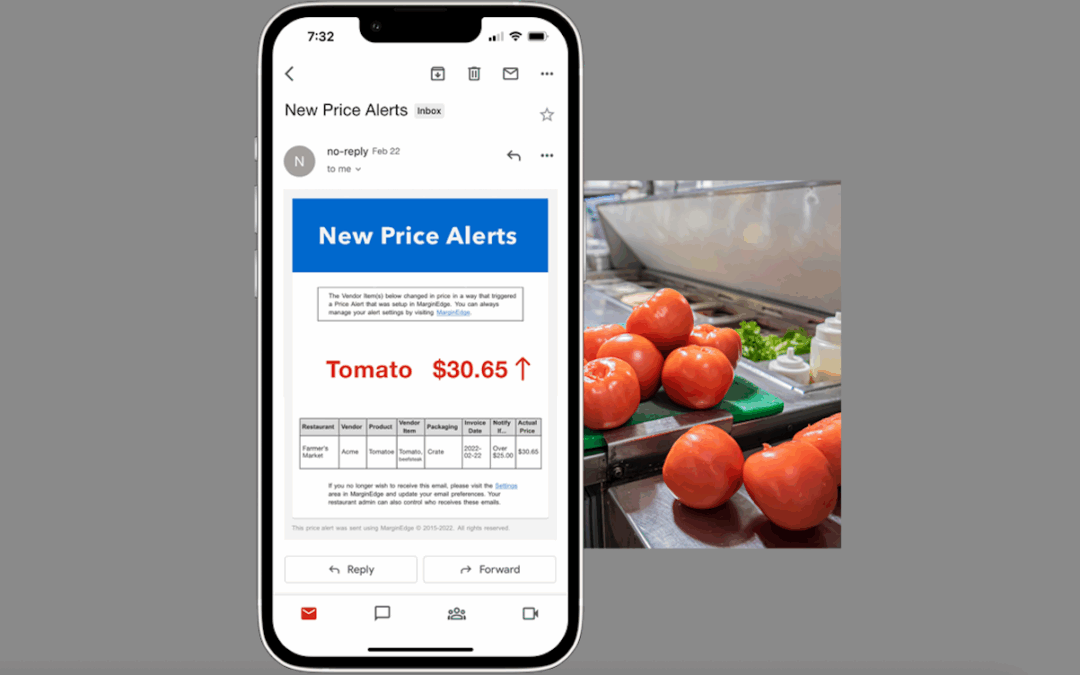
“With natural language processing, if you’ve got recipes in Word documents, you can just cut and paste your inputs,” he said. “If you have a pound of red tomatoes and you have terms for it like RT and LB, the machine learning has gotten so good at understanding natural language that it can process all that into the taxonomy of the red tomato structure. We can tell you much a red tomato costs because we’re processing billions of dollars in purchasing. And we can show you the seasonality. We can show you costs over time. We can do that with each of your ingredients.”
Once operators get a taste of machine learning, Davis is confident they will become true believers. And the capabilities should only continue to improve.
“We didn’t get less cars when we brought robots into factories to make cars. We just got more and better cars. The same thing’s going to happen with software and the restaurant industry. It will continue to get better,” he said.