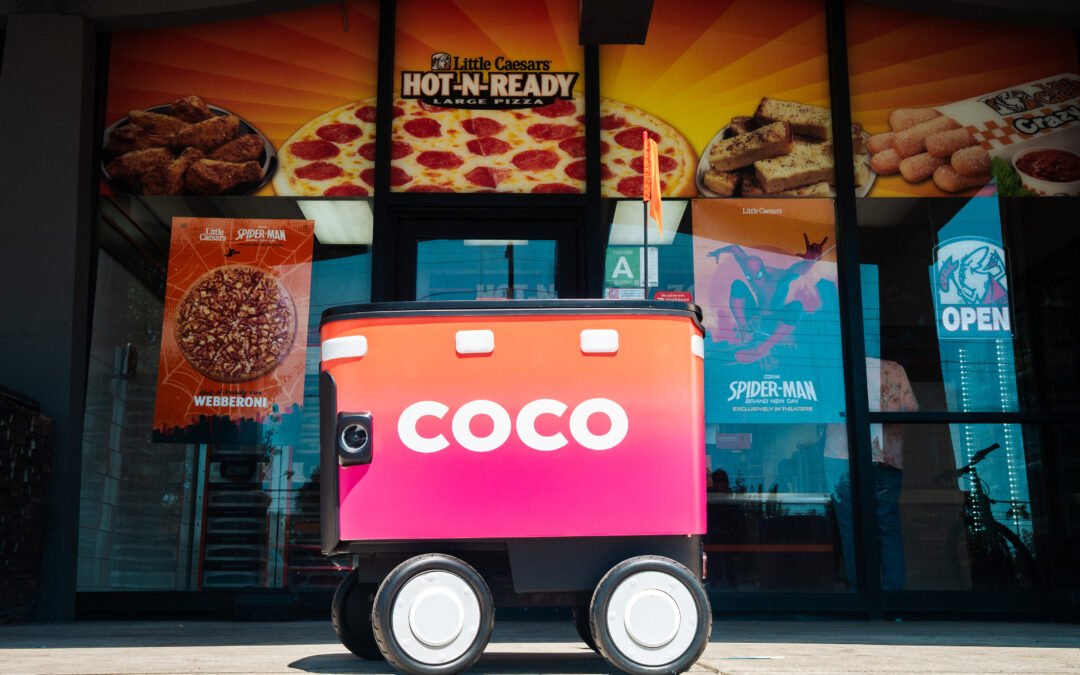
Nearly 18 months after autonomous delivery company Coco began testing services with Michigan-based chain Little Caesars, the companies announced a partnership integrating the delivery robots into the convenience-oriented pizza brand’s operations, marking the start of broader rollouts.
Coco announced the partnership August 19, expanding autonomous robot delivery to Little Caesars locations throughout Los Angeles, Chicago, Miami, and, within the month, San Jose, California — the company’s latest service area.
In a statement to Food On Demand, Trish Heusel, Little Caesars’ vice president of innovation, noted Coco’s experience, proven ability to scale, and integration with DoorDash and Uber Eats as key benefits leading to the partnership.
“Coco gives us another way to deliver on what Little Caesars has always stood for: convenience, speed and value,” Heusel said. “The robots can help us get orders to nearby customers quickly, especially during busy periods, while easing congestion around delivery pickups.”
For decades, Heusel said, targeted innovation has been critical in Little Caesars’ approach to improving the guest experience, streamlining restaurant operations and building value for franchisees.
“What’s exciting is that this futuristic technology solves a very practical challenge,” Heusel said. “Guests order through the same platforms they already use, and our restaurant teams don’t have to manage a separate system. It’s advanced technology that makes getting a hot, delicious pizza even simpler. We believe Little Caesars already offers some of the fastest pizza delivery out there, and Coco helps us make it even faster.”
In a statement to Food On Demand, Melissa Fahs, Coco’s vice president of enterprise, said that focus on delivering value with an emphasis on speed made Little Caesars a natural fit for partnering with the autonomous delivery firm.
“We started with Little Caesars stores in Los Angeles, our largest market, and worked closely with their team and our marketplace partners to integrate Coco into their existing delivery operations,” Fahs said. “From there, we’ve been able to build on that experience and expand the partnership to more locations across Los Angeles, Chicago and Miami, with San Jose coming soon.”
Fahs said Coco’s experience delivering for other restaurants through DoorDash and Uber Eats gave the firm confidence that autonomous delivery could satisfy Little Caesars’ speed and scale requirements.
“The testing period [beginning early 2025] demonstrated that autonomous delivery can integrate seamlessly into Little Caesars’ existing operations, and now we’re expanding that model across more locations,” Fahs said. “The process is simple for restaurant teams: the robot arrives at the store, the team loads the hot order, and Coco handles the delivery from there. As we expand, autonomous delivery gives Little Caesars another efficient way to manage delivery demand while allowing restaurant teams to stay focused on preparing and serving customers.”
For now, Coco is focused on scaling third-party delivery experiences to more locations. Still, Fahs said, the company will continue building the partnership with Little Caesars and explore opportunities to expand use cases for autonomous delivery to support its operations over time—potentially including first-party delivery.
Beyond the recent Coco announcement, the Detroit-based pizza brand’s autonomous delivery efforts include a collaboration with Serve Robotics to transport Los Angeles-area orders and a partnership with drone-delivery company Flytrex, which, as of April, directly integrates with Little Caesars’ ordering systems for orders placed via the Flytrex app.
“Our immediate goal is to deliver a great experience in participating markets and learn from the results,” Heusel said. “Over time, we’ll explore opportunities to serve more guests and restaurants while making short-distance delivery faster and more efficient. Any expansion will be guided by performance, guest feedback and the needs of our franchisees.”
Regarding Coco’s long-term goals for the partnership, Fahs said expanding services to additional Little Caesars locations and bringing autonomous delivery to more guests are at the top of the list.
“This rollout across Los Angeles, Chicago, Miami and San Jose is an important start, and we see an opportunity to build from there as we continue demonstrating how autonomous delivery can fit into Little Caesars’ operations and serve more of its guests,” Fahs said, adding that Coco is actively expanding into new markets—creating additional autonomous delivery opportunities for the pizza brand.
Partnering with a well-known national brand like Little Caesars helps demonstrate that Coco’s autonomous delivery fleet can operate at the scale and pace required by high-volume operations.
“Little Caesars is especially meaningful because speed, convenience and value are what their guests expect—including for delivery orders,” Fahs said. “Showing that our robots can integrate into that kind of fast-moving operation is a strong signal to other national and regional brands that autonomous delivery is ready to become a practical part of their business—not just an interesting technology to watch.”