If imitation is the sincerest form of flattery, VoicePlug offers one sincere ordering capability.
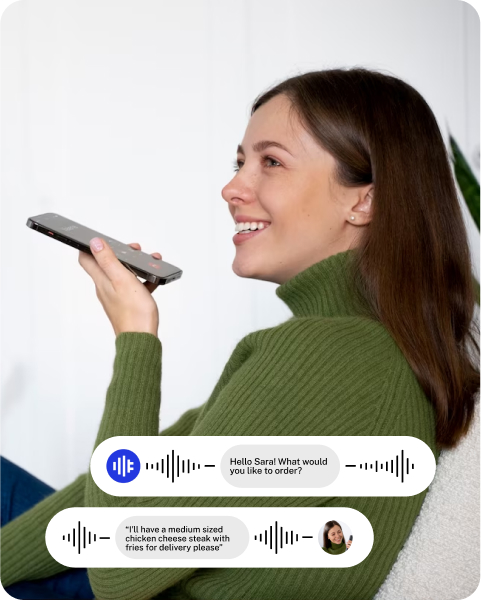
VoicePlug, a provider of AI-powered voice solutions, has a feature in which the pace of a consumer’s order is mimicked by the AI.

Jay Ruparel, co-founder and CEO of VoicePlug
“When we work with a brand, we create a voice persona for it, which can include the accent, dialect, and the pace in which the AI speaks,” said Jay Ruparel, co-founder and CEO of VoicePlug, in an interview. “Our effort is to offer a human-centric AI experience.”
VoicePlug recently announced that its conversational AI is now integrated in Qu’s unified commerce platform. “We’re thrilled to bring VoicePlug’s real-time conversational AI into the hands of Qu’s restaurant customers,” he said.
Operators have come a long way in getting comfortable with AI.
“When we started as a native AI company four years ago, restaurants didn’t know what AI could do,” he said. “We had to explain the concept.”
But a tipping point happened about 18 months ago, according to Ruparel.
“It was about then that QSRs and fast casuals, who are under enormous pressure to improve efficiency and cut costs, started understanding how AI can help them, which has created rapid momentum,” he said.
There are still holdouts. People are still confused. Ruparel is confident that he can show bottom-line results quickly if an operator gives it a chance.
“We can show ROI not in months but in weeks,” he said. “It’s not uncommon for us to be able to show an increase in the number of orders after week one.”
Ruparel has detected a change in consumer comfort in the past couple years. “With our initial installs, we would allow the customer to choose if they wanted to speak to a person, and many would,” he said. “But now we see a significant change where more guests are not wanting to hold the line for an operator but are happy to just talk to the AI.”
VoicePlug is hoping to capitalize on another consumer dynamic when it comes to mobile ordering.
“There are people who find it challenging to tap all the customizations for say a pizza on an app, but they do better if they can speak them,” he said. “Statistics show that humans speak three times faster than they type so that makes sense. We see rapid adoption in that direction.”
VoicePlug can offer a variety of customized voice solutions because it has developed a deep inventory of audio.
“We have built an engine that uses real audio conversations. The accuracy it gives is quick because an order does not go through a large language model, but a restaurant-domain language model. We built it from the ground up to allow for high accuracy and low latency. We can provide contextual understanding of the consumer. We can tell who the primary speaker is in the car in a drive-thru order,” he said.
And once an order is captured, the information is retained and that knowledge applied when a customer reappears.
“Guests love it when an AI can say, ‘Hey John, welcome back. Would you like to repeat your previous order?’” he said. “Or when they order X, they also order Y. They love tailor-made transactions.”
Ruparel’s pitch to operators is to imagine a day when staffers don’t have to multi-task quite so much.
“There is so much stress in having to pick up the phone, especially during peak hours where guests are coming in. It’s such a relief to have an AI assistant handle tasks that are repetitive,” he said. “You don’t have to worry about off-premises orders that can be handled by the AI. We see the technology as empowering operators to do more with the same team.”
The market is growing rapidly. Voice AI in restaurants is projected to expand from $10 billion to $49 billion by 2029, according to a report from Checkmate. Forty-one percent of operators in the U.S. plan to use AI to forecast sales, and 33 percent say they are using the technology to personalize customer experiences. Industry observers are expecting big things.
That’s the macro landscape. The micro is in understanding the mindset of each consumer, says Ruparel.
“That person is hungry,” he said. “The last thing you want is to introduce errors and ask them to repeat an order. Voice AI can ensure you don’t.”