This article originally appeared in Franchise Times, a sister publication to Food On Demand.
An operator of more than 800 convenience stores is turning to sandwiches.
RaceTrac, the Atlanta-based company that runs hundreds of RaceTrac and RaceWay c-stores, plans to acquire Potbelly in a roughly $566 million take-private deal that William Blair analysts called “surprising.” The all-cash transaction, announced September 10 and set to close in the fourth quarter, values Potbelly shares at $17.12 each. That’s a 32 percent premium to the September 9 closing price.
Bob Wright, CEO of Chicago-based Potbelly, said RaceTrac leadership “has loved the brand for a long time” and made an unsolicited approach several months ago, after which “things moved rather quickly.”

Potbelly CEO Bob Wright
Potbelly, Wright continued, “had not contemplated any strategic alternatives … including a sale,” and remains excited about its growth strategy, which includes a big franchise expansion push as it approaches 500 restaurants. And while RaceTrac has stores across 14 states and operates another 1,200 Gulf fuel stations after buying Gulf Oil in 2023, don’t expect to see Potbelly popping up inside their locations.
“This is not a play where you just try to figure out how to put Potbelly’s food in the convenience store,” said Wright. “We are a restaurant concept, and they’re buying us as a restaurant concept. When you look at the premium they’re paying for the company, you would assume they see value in us as a standalone part of their portfolio.”
Natalie Morhous, who as RaceTrac’s CEO and chairman is the third-generation leader of the privately held company, did not comment for this story, but in a February interview with Atlanta magazine she said the company is setting itself up as a competitor to the restaurant industry.
“We are making pizza and frying chicken in stores, and we have many of our own proprietary food offerings. We have been able to position ourselves as truly a one-stop shop for people on the go. We offer fuel and snacks, but they’re also able to get a hot meal that doesn’t require a second stop,” she told the magazine.
Potbelly pursues franchise growth
Potbelly has 445 restaurants, nearly 80 percent of them company-owned. The brand did $560.5 million in systemwide sales last year, a scant 0.1 percent increase from 2023, according to Franchise Times Top 400 data. Same-store sales last quarter increased 3.6 percent; restaurant-level margins grew to 16.7 percent, up from 15.7 percent last year. The company reported a slight uptick in traffic.
Wright joined Potbelly in July 2020 amid a slowdown in sales and traffic, which the company previously sought to address by raising prices. Customers, however, didn’t think the cost of a sandwich matched the product. Among Wright’s first moves was to retool the menu by making the brand’s original sandwiches heartier and introducing a line of “skinny combos” at a $7.99 price point. And with 40 percent of total sales coming through digital channels, Potbelly over the past two years rolled out its Potbelly Digital Kitchen, a tech-driven system better able to sort orders and utilize a restaurant’s second make-line.
In June, it relaunched its website and app.
The average unit volume at 73 traditional franchise stores was $1.2 million last year. Company-owned shops measured, 330 of them, averaged slightly higher sales. That AUV is almost double what it was in 2020, when Potbelly was contending with multiple years of sliding sales and unit closures.
Potbelly in 2022 announced a goal to hit 2,000 units over the next 10 years, 85 percent of them franchised. It’s refranchised several sets of company stores, signed new deals such as a 13-unit agreement for Seattle and even attracted former CEO Bryant Keil back as a franchisee.
An incentive program launched earlier this year is drawing more new multi-unit operators.
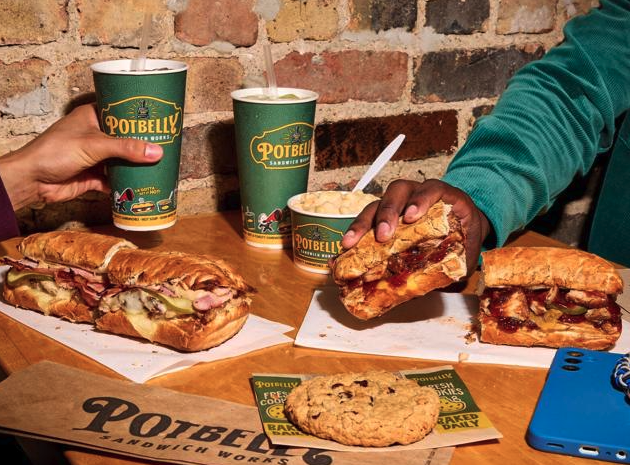
Potbelly added Cuban and barbecue pork sandwiches to its menu last year as part of its ongoing innovation push.
While Potbelly and RaceTrac operate in different industries, Wright noted both are multi-unit, multi-market, consumer-facing businesses, and there are opportunities to take advantage of RaceTrac’s “significant resources, capabilities and experience that can accelerate our growth plan.”
Franchisees are absorbing the news, he said, and the initial reaction has been positive. Potbelly has been publicly held since 2013, and franchisees “recognize the value of a family-owned, private business.”
“They’re delighted to know that Potbelly is going to be under an ownership structure that’s always had a long-term view and a growth-centric view and a future orientation to everybody in the system doing well,” he said.
Last fall, large Potbelly shareholder Immersion Investments sent an open letter to the company’s management and board of directors in which it urged the company to evaluate a sale. Immersion also wanted Potbelly to consider an aggressive share repurchase program and the slashing of internal investments in technology and headcount.
Wright said the decision to sell to RaceTrac is “completely unrelated” to Immersion’s suggestions, which he noted were “short-term ideas to try to drive the share price.”
The close of the transaction, he continued, will yield “significant value” for shareholders.
“We haven’t seen a stock price like this since shortly after the company went public back in 2013,” Wright said. “So, it’s a win for our franchisees, it’s a win for our people, certainly a win for the growth of the brand, a win for RaceTrac, and our investors do really well also.”
In their equity research note, William Blair analysts Sharon Zackfia and Tania Anderson wrote the deal valuation “is at a premium to what Potbelly has historically averaged.”
“While the deal valuation leaves the potential for other bidders to emerge, the reality is that Potbelly has traded below the proposed bid for a very long time and no other suitors have previously emerged,” they wrote. “As a result, we suspect the deal will find the necessary 40 percent of shares to move forward, with existing holders apt to take the win on the deal.”
So far, Potbelly’s leadership team remains in place. On September 9—the day before the acquisition was announced—the company approved deal signing bonuses for Steven Cirulis, the chief financial and chief strategy officer, and Adiya Dixon, the chief legal and chief compliance officer, equal to 30 percent of their base salaries and payable in cash following the close of the transaction.
Of his future with the brand, Wright said he’s “still running this company, and until we get absorbed then we’ll have that conversation. I will certainly report to Natalie, and then we’ll see where we develop over time.”