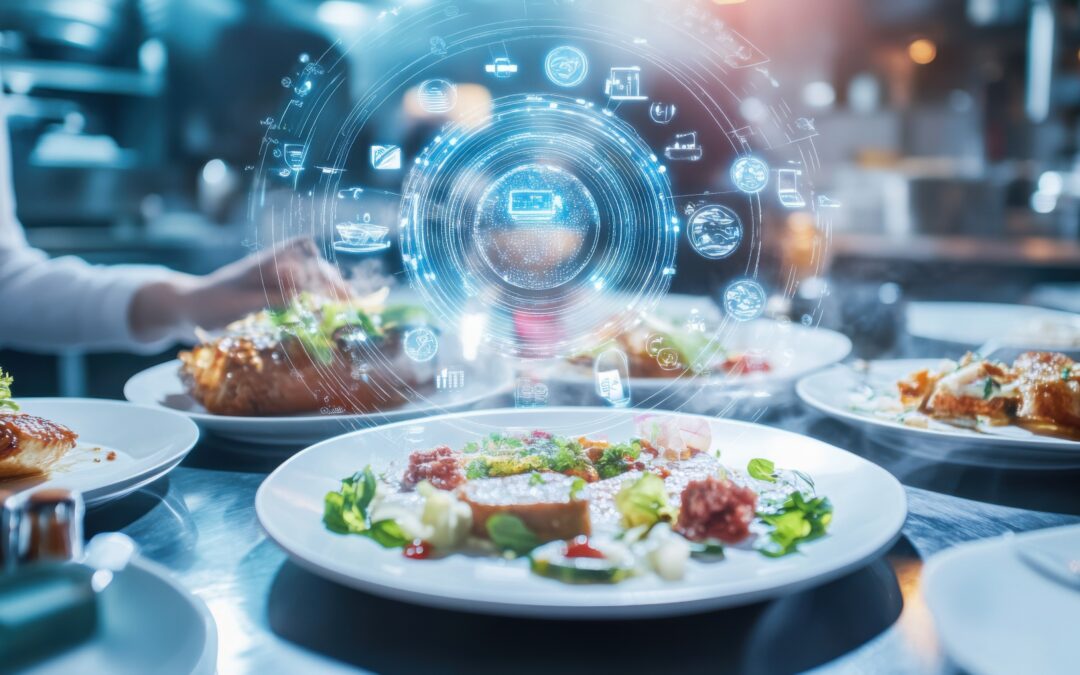
A group of restaurant brand leaders were joined on stage at the recent Create Investment Summit in Nashville for an in-depth discussion on utilizing new AI technologies.
The panel was led by Maria Zhang, CEO of Palona AI, who guided the conversation around how AI is being implemented for customers and employees alike. Across the board, the sentiment on utilizing AI was similar, with many brand representatives noting where and where not to use it.
“I think of AI as an instrument in the orchestra, versus it being the conductor,” said Sergio Perez, chief marketing officer for Emmy Squared and the Pizza Loves Emily Restaurant Group. “For me, it’s how I’m leveraging AI for messaging and copy that will lead to conversion. Brand will always be king. It’s about leveraging technology to amplify that.”
Perez, whose companies are based in New York, added that AI has also been helpful in more efficient store data analysis, eliminating the need for larger teams to crunch the numbers.
Troy Hooper, CEO of Hot Palette America, parent company of 551-unit Pepper Lunch, had a similar view in using digital conversions to enhance what’s already in place.

Troy Hooper, CEO of Hot Palette America
“For me, technology has to solve a problem that can make us more hospitable,” Hooper said. “Something that gives us the ability to make us more productive, efficient and guest-centric, so our workers have tools at their fingertips making their jobs easier and productive. Technology can change a guest’s journey that way, either from improving the employee’s workflow or having less friction for the customer.”
“As these technologies emerge, especially with AI, it can induce a lot of fear because there are tropes out there about AI taking over peoples’ jobs,” said Shaz Khan, president of Minnesota-based Tono Pizzeria + Cheesesteaks. “That’s not our goal. We’re strong in our ethos and communicating that to our team, ensuring them at all junctures that we’re focused on making this the best place for them. At the end of the day, we bring them tools.”
Khan’s business, which has 10 locations, is also bringing AI onboard to process analytics, similar to what Perez’s company implemented.
“As a small business owner, coming from one unit to where we are now, the importance to having access to data is paramount,” Khan said. “The more organization I can bring to the chaos that is restaurant operations, the better it is for the team.”
Outside of a restaurant’s four walls, Ha Ly, chief marketing officer at Pokeworks, said AI has shown to be effective in advertising production while adhering to the brand voice. However, for the 76-unit concept, AI usage doesn’t stop with just brand awareness.

Shaz Khan, president and Tono Pizzeria + Cheesesteaks.
“Our team was able to build a tool where they could get all of the weather patterns for each city, for lunch time and dinner time,” Ly said. “We then triangulate that with all of our subscribers and send emails out. So, if it’s too hot, we offer a discounted drink, if it’s too cold, a deal on soup. Before AI, you’d have to hire a whole team to do that.”
For Pepper Lunch, the technology allowed the brand to create an entirely new layer to its overall identity. Hooper said the concept, after about a year-and-a-half, created a new mascot titled Pepe, which was partially created using AI engines. Once launched, Hooper said it will be able to interact with guests across social media platforms.
Hooper added Pepper Lunch is also incorporating AI technology in its phone system, bringing on Palona Voice.
“It can help reduce friction,” Hooper said. “I don’t know if anyone even calls Pepper Lunch, but if I make that an option for the guest, adding another modality, and I tell the customer what it’s useful for, we can provide answers to a lot of the questions customers want to ask us. We can make those answers readily available to them. It’s not always about replacing something or making something you have better. It can be something totally new.”
Before any step forward can be made on any new technology, though, at Friedman’s Hospitality Group, Chief Technology Officer Anne Chiao said any digital venture must be dependable.
“The most important thing from technology providers is reliability,” Chiao said. “At the center of hospitality is reliability, because it builds trust. I cannot run a restaurant if I can’t rely on my chef to come in on time. So, when I look at technology platforms or AI, I’m looking at its reliability, and trust with the people behind it.”