Since its start as a single food truck serving college students in 2008, Boston-area vegetarian fast-food concept Clover , a 2026 Food On Demand Outstanding Operator, has made a name for itself serving dishes that consumers often literally cannot find at other restaurants.
Having surpassed a dozen brick-and-mortar locations this month, the strategy has proven effective in cementing a brand identity and in garnering a loyal plant-based clientele throughout Clover’s 18 years of business. Still, the approach provides distinct logistical challenges and other hiccups to maintaining well-oiled off-premises operations.
“Our menu changes with extreme frequency, much more than the standard within the industry, and that’s because we respond in real time to farmers as the growing season continues,” said Kiernan Schmitt, Clover’s chief marketing officer. …”(If farmers say), ‘I’ve run out of Brussels sprouts, but I have a bumper crop of sweet potatoes.’ We overhaul our entire menu to feature our sweet potato soups, the Japanese sweet potato sandwich, (and) sweet potato salad.”
With menus that change on a dime in response to agricultural factors and kitchens unafraid to experiment with new recipes, the brand embraces its “atypical” status in the quick-service restaurant scene. However, several of the factors that helped Clover stand out as distinct made choosing an ideal tech stack a complex puzzle for the brand.
“A bunch of our work over the past year or two has been to get our technology to move at the pace of the menu,” Schmitt said. “It’s what people find exciting about us. It’s also what brings the best flavor to the food, because, obviously, what’s freshest locally is what’s going to taste the best.”
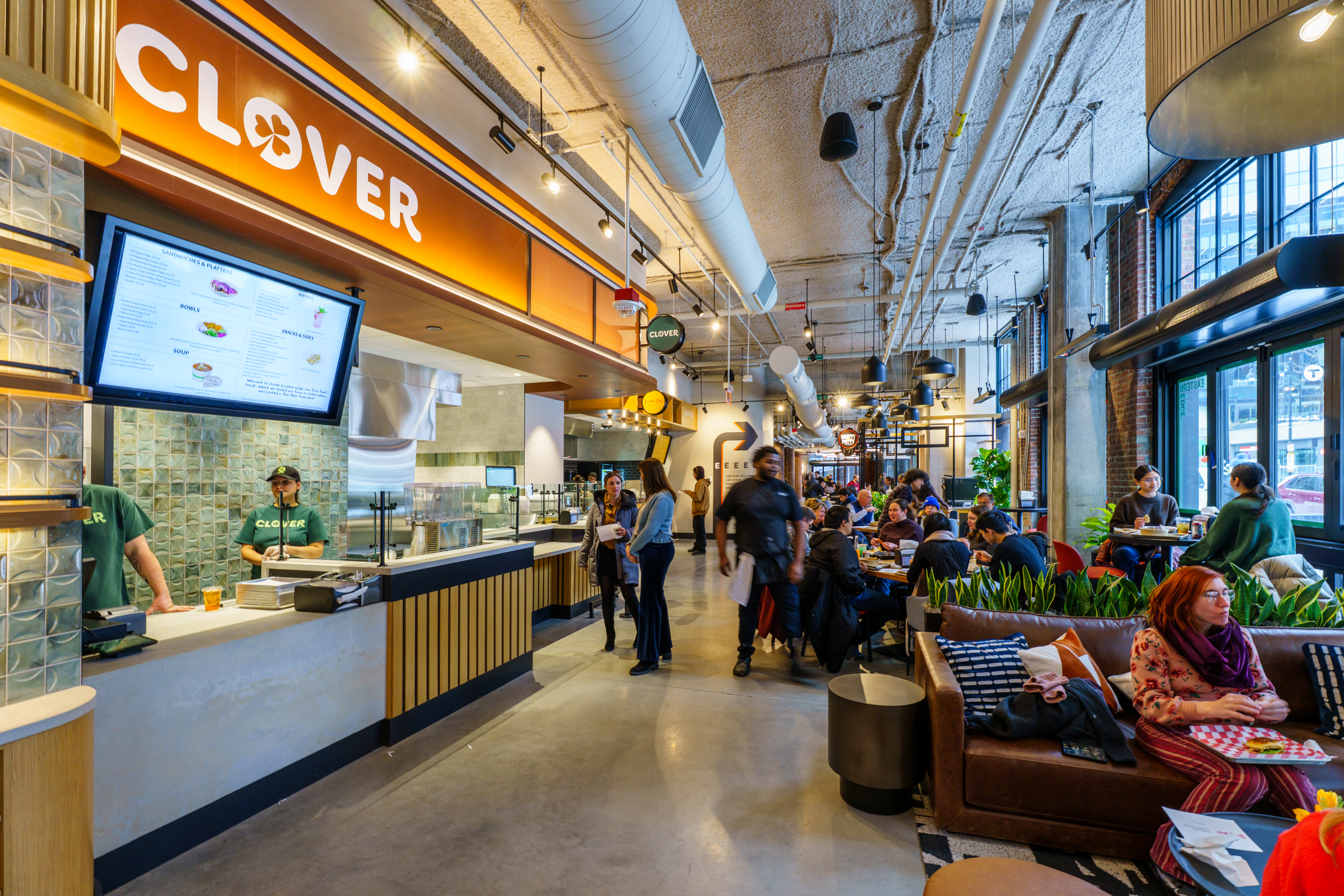
Photo by Drew Katz
Schmitt said Clover’s catering program led the way for the brand’s off-prem innovation under catering director Mary Shillue-Goldberg. Shortly after starting with the vegetarian fast-food chain, she revamped the catering menu with specific focuses on packaging, transportability and allergen awareness.
“When I came into clover, we had a catering menu that was very closely tied to our restaurant menu,” Shillue-Goldberg said. “It essentially was mostly just the restaurant menu items. And some of those, as you might imagine, are really great for catering and travel really well; other shine better in a quick service format.”
Clover rolled out a first-party catering channel in early 2025, which Shillue-Goldberg noted as key to the program’s success.
“For many years, Clover was focused on that in-house dining experience,” Shillue-Goldberg said, reflecting on changes in the brand’s approach to catering since mid-2023. “So, with the growth of the catering program as an organization, Clover really understands — from our frontline workers up to our executive management — the different needs of the off-premises customer, whether that’s food at work, event-based celebrations and things like that, and different customer profiles.”
Clover uses an internally developed point-of-sale system and app for in-house purchasing. Schmitt said internal POS gives the brands control over how they present themselves to guests and how they collect customer data.
“It’s making sure that we’re segmenting and delivering messages to audiences that are most relevant to them,” Schmitt said of the Clover POS system. “We’re also looking at their buying behaviors to help dictate how we change the user experience of ordering. Of course, that means, like prompting additional purchases, prompting upsell, and creating easy moments to do that.”
Schmitt, who started his role with Clover about four years ago, said the brand initially avoided adopting third-party ordering, in part, because of service fees and marketing costs, until the Coronavirus pandemic forced its hand.
“It’s difficult, within margins, to make that (3PD) work for the operator and still have it be profitable,” Schmitt said. “But of course, once Covid hit, it became a necessity for the restaurants, because everybody wanted it.”
The pandemic also inspired Clover to start offering meal boxes, which provide recipients with ingredients and simple instructions — essentially, everything but the “last 5 minutes of prep,” according to the brand’s website.
Because Clover’s menu and approach to food intentionally differentiate it from competitors, Schmitt said the brand works with 3PD platforms to appear more approachable. Whereas in restaurants, staff discuss ingredient sourcing and flavor profiles with guests in person — a luxury not available to off-prem customers.
Schmitt credited Olo as the most influential tech partner regarding enhancing Clover’s off-prem operations. Prior to that collaboration starting last year, restaurant staff entered 3PD orders themselves, which added a layer of friction and increased the risk of error.
“We did hook up with Olo last year, and that has been just tremendously helpful, driving operational efficiency,” Schmitt said. “Now, we have all third parties go into Olo and the restaurant. Our catering now has a direct portal. Prior to that, it was either manual through a salesperson or through ezCater, but now we have that direct relationship with the catering customer.”
As a brand, Clover reached a full-circle moment this February, opening a brick-and-mortar location in Kendall Square at the Massachusetts Institute of Technology, a couple hundred feet away from where the initial food truck once served the brand’s first customers in 2008.
The Outstanding Operators Program highlights 20 innovative brands taking creative paths to success with all things off-premises. Each winner receives a $1,000 charitable donation to their organization of choice and will be recognized on-stage at the 2026 Food On Demand Conference. Register today!
 |
 |
 |