The Webster’s definition of loyalty is to be faithful to a cause, ideal, custom, institution, or product. This is the dream of any operator. Yet there is no one way to form it. Brands use a multitude of tactics. Yet one commonality is that it’s important to try.
Data agency Circana released research last month that showed that restaurant loyalty traffic doubled from 2019 to 2024, and loyalty members now represent 39 percent of total restaurant visits. And get this: although overall restaurant traffic declined by 2 percent in 2024, loyalty traffic increased by 5 percent.
The question is how to do it? We asked three brands with three distinct loyalty operations how they approach it.
Blaze Pizza: Eliminate the Guest Checkout Option
Blaze Pizza has more than 340 locations in 38 states. The brand takes an all-in approach to cementing loyalty.

Casey Terrell, chief marketing officer at Blaze Pizza
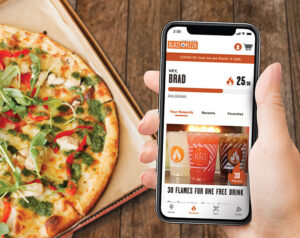
“For us loyalty is the same as e-commerce,” said Casey Terrell, chief marketing officer, in an interview. “There is no guest checkout. Online orders and loyalty are the same. We can look at our online purchases as a percentage of our business and know those are all loyalty people.”
In April the brand converted its tech stack from a custom solution to a more affordable white-label platform. “This has allowed us to put more money into outreach,” he said.
Which lets it gather and assess more data. “We have a great director of omnichannel marketing who lives in our data,” he said. “He is constantly doing test and learn. That’s the big thing. How do we do if we use this offer? Am I going to get more people to give us their phone number? How have our drip campaigns been working? With our current platform we have more understanding of who our guests are.”
Blaze deploys its refashioned tech capabilities to target consumers with hyper-segmented offers. It delivers messages via email and SMS texts. Consumers who order through first-party channels receive special offers and lower pricing. “SMS outreach is really effective for us. It’s like a 98 percent open rate,” he said.
 Next for the brand is to add a customer-data platform, which it is doing right now.
“That will help us understand the majority of our guests, from the POS right down the line,” he said. “We’ll have more demographic insights and the ability to combine our Thanx and Olo data with new data.”
Enhanced understanding is the grail. Right now, between in-person visits and online orders, “it’s like running two businesses,” he said. “We’ve had to use loyalty and digital orders as a proxy for everything in the brand because that’s the only thing we had. But now we’re looking at the differences between our in-store customers and online customers. That’s a really interesting challenge we’re hoping to solve this year.”
Kahala Brands: Make Loyalty About More Than Visits
When you oversee the loyalty programs for 28 retail brands, as Brandon Hodgins does for Kahala, one thing must be top of mind: there is no one-size-fits-all solution. But with that in mind, he has found some truisms. One is about SMS marketing.

Brandon Hodgins, director of loyalty marketing at Kahala
“Everyone has a smart phone,” said Brandon Hodgins, director of loyalty marketing, in an interview. “I think it’s over 90 percent of Americans. It makes the communication real immediate. I might check my email once or twice a day but if I get a text message, I look at my phone.”
If Kahala can get consumers to look, it can often get them to spend. “If we invest $1 on SMS marketing, we generate $9 in revenue,” he said.
It’s consumer spending that the brand rewards, not just visits.
“We don’t want purely visit-based loyalty,” he said. “We want to tie it to total spend. That way it’s a blend of visitation and spend per check. If you just do visitation you can end up in a bad place, especially if you have a high-frequency restaurant, like a coffee shop. You want more of a point-based program.”
Hodgins views loyalty as a value exchange with consumers.
“You’re giving discounts in exchange for their data,” he said. “The way you make money over time is using that data and communicating with guests, through email or texts or by advertising to them. If you’re not leveraging all those tools, you’re not fully utilizing your loyalty. You’re not squeezing every ounce of juice out of the lemon.”
Just be careful not to squeeze lemon juice in your eye. This can happen if a brand asks too much of a consumer to qualify for loyalty. App fatigue is real.
“A lot of consumers don’t want to devote real estate on their phones anymore,” he said. “With phone numbers a guest can walk in and punch their number directly on the guest-facing screen, or a cashier can take it. It’s less friction. That’s not to say a brand shouldn’t have an app and tie it to loyalty. But I don’t think it should be mandatory.”
Hodgins offers a formula to keep in mind.
“Our philosophy is we want a really high adoption rate, which is the number of loyalty transactions divided by the total number of transactions,” he said. “If your loyalty is app-based you’re just artificially lowering that rate. That means fewer participants in loyalty, which means less data, which means less revenue over time. I want as many people in our program as possible.”
It is no secret that last year presented challenges to operators, with inflation keeping some consumers away. Kahala adjusted its loyalty strategy without abandoning its central tenets.
“When people were spending more money I would do offers around points, like free rewards for spending a certain amount. I would double the points that a consumer spends. I like those kind of offers in those times,” he said. “We’ve definitely switched to being more discount heavy this year. But we’re still mixing in our normal rewards.”
Cooper’s Hawk: Be Creative With Your Memberships
 The Cooper’s Hawk experience is unique. The concept has four components: an upscale casual dining restaurant, full-service bar, private dining room, and Napa-style tasting room and retail gift store. Its claim to fame is its wine club. This is no ordinary wine club. It boasts nearly 800,000 members, making it the largest wine club in the world.
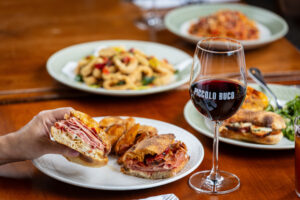
The brand does everything it can to add value for those members. This includes a variety of food and wine rewards from its more than 60 Cooper’s Hawk locations and two Piccolo Buco pizza restaurants, with whom it is partnered.

Jason Plutz, chief restaurant officer at Cooper’s Hawk
“Members earn points for every dollar they spend,” said Jason Plutz, chief restaurant officer, in an interview. “For every 350 points that a member accrues, they receive a $25 certificate. That’s just one benefit. On your birthday, you get a $15 birthday reward. For every five bottles of wine, you get 10 percent off. For six to 11 bottles, you get 15 percent off. And for food you get 10 percent off carryout and catering. And that’s just part of it. We have all these rewards and benefits that go with being part of Cooper’s Hawk.”
The wine-club benefits translate across restaurants. “We want to give our members a differentiated experience,” he said.
The strategy with Piccolo is to give members another experiential perk. Wine club members can use benefits such as loyalty points and discounts at Piccolo Buco and pick up their wine of the month on site. About 40 percent of Piccolo Buco consumers are wine club members, which is similar to the ratio at Cooper’s Hawk.
“We want to create an incredible experience for our wine-club members and customers,” he said. “And that is translating to our growing Piccolo Buco locations, with the next one opening in Tampa later in the year. It’s working. People love the pizza and the wine.”