This article was originally published on Franchise Times, sister publication to Food On Demand.
Now more than ever, franchisees and franchisors of emerging restaurant brands are finding ways to evolve and drive innovation in an industry far from stagnant.
With rising costs, labor shortages and changes to technology, building success is possible—but that’s easier said than done.
“You have to find a way to do innovation in a way that is authentic to your brand and brand’s voice that feels honorable to you, so the consumer isn’t just looking at whatever random product you’re putting out there at any given time,” said Adam Saxton, co-CEO of The Saxton Group, one of the largest franchisees for McAlister’s Deli with about 80 units across Kansas, Oklahoma and Texas.
“I also think that in a time of less traffic and the consumer feeling a little bit of a pinch,” he added, “it’s a great time to focus on some of the fundamentals of the restaurant business that we all know work really well.”
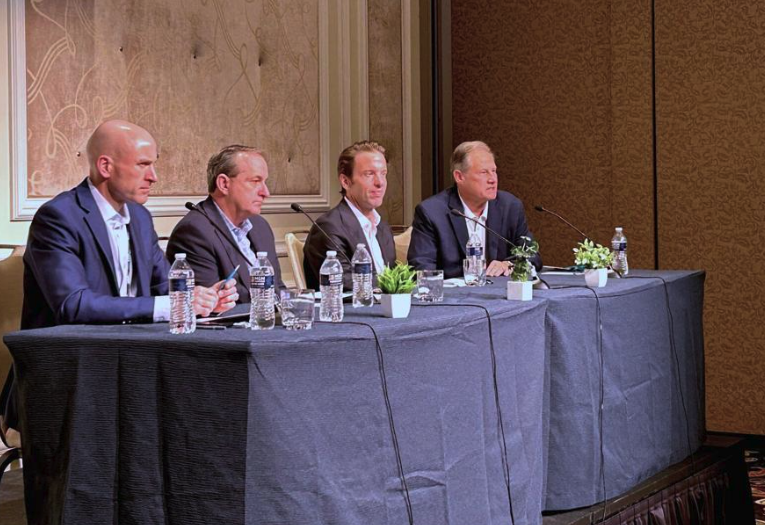
Saxton spoke on a panel about emerging brands controlling operations alongside Heritage Restaurant Brands CEO Greg Graber and Luna Grill Chief Financial Officer Steve Brake. Chris Banse with RSM US moderated the session at this year’s Restaurant Finance & Development Conference November 11 at the Bellagio in Las Vegas.
The Saxton Group has grown with the fast-casual deli concept over 25-plus years and was the first to franchise with Jaggers, a fast-casual concept owned by Texas Roadhouse.
Part of the GoTo Foods portfolio, McAlister’s generated $1.02 billion in systemwide sales for 2024, according to Franchise Times Top 400 data. The company reported an average unit volume of $1.9 million last year, per its franchise disclosure document.
Industry professionals said success has come from doubling down on hospitality. Case in point is the culture at Heritage, the franchisor of 35-unit Southern breakfast and lunch concept Huckleberry’s, six-unit Perko’s Cafe Grill and a new concept, Press Quesadilla Grill, with franchise units in development.
Huckleberry’s “Southern cookin’ with a California twist” cuisine warrants Southern hospitality, which Graber said is reflected across the guest experience and franchise system at large.
“In taking care of your guests, there is no substitute for connection between a team member that understands the culture and understands who that guest is,” he said. “You can get service from an ATM, but you can only get hospitality from a personal connection.”
Top 400 data shows Huckleberry’s finished last year with $59 million in systemwide sales, a 2.8 percent increase from 2023. Unit growth rose 5.9 percent.
The strategy behind discounting has varied for brands depending on their unique positioning and customer base. With this, Saxton advised franchisors to be intentional about promotions and not see them as a catch-all to offset revenue struggles.
“Just dropping a random reward in a loyalty account probably is not enough to really break through to the consumer,” he said. “So I do think we need to start looking for ways beyond that to acquire the right kind of customer, and to make sure that if we’re giving a discount, it feels like a meaningful act of service and not just a random coupon being dropped into an account.”
Food costs also continue to be a focus for emerging players; franchisees and franchisors said they have to keep each other in mind when navigating rising costs.
From a franchisee perspective, Saxton said potential operators should ensure the brand they plan to sign with “has a really great purchasing organization.”
“In areas and times like this when you’re having increased cost pressure and there’s been a lot of inflation,” he continued, “you really hope that purchasing side of the business for the brands that you operate is super buttoned up.”
Graber agreed with the need for a solid, communicative franchisee-franchisor relationship, highlighting the importance of making decisions with the franchisees in mind.
Related: Top 400 Breakout Brands Sport Strong Sales Growth
At Huckleberry’s, Graber has leaned into predictability as a traffic driver amid volatility. He said this aspect of the brand’s menu engineering leads consumers to order more of what you want them to and be able to leverage consistency in discussion with manufacturers and suppliers.
“Food costs that are rising—yes, it drives operators crazy. The unpredictable food cost drives them even crazier,” he said. “You want to have some predictability and to know what’s going … so we can make sure we deliver value.”