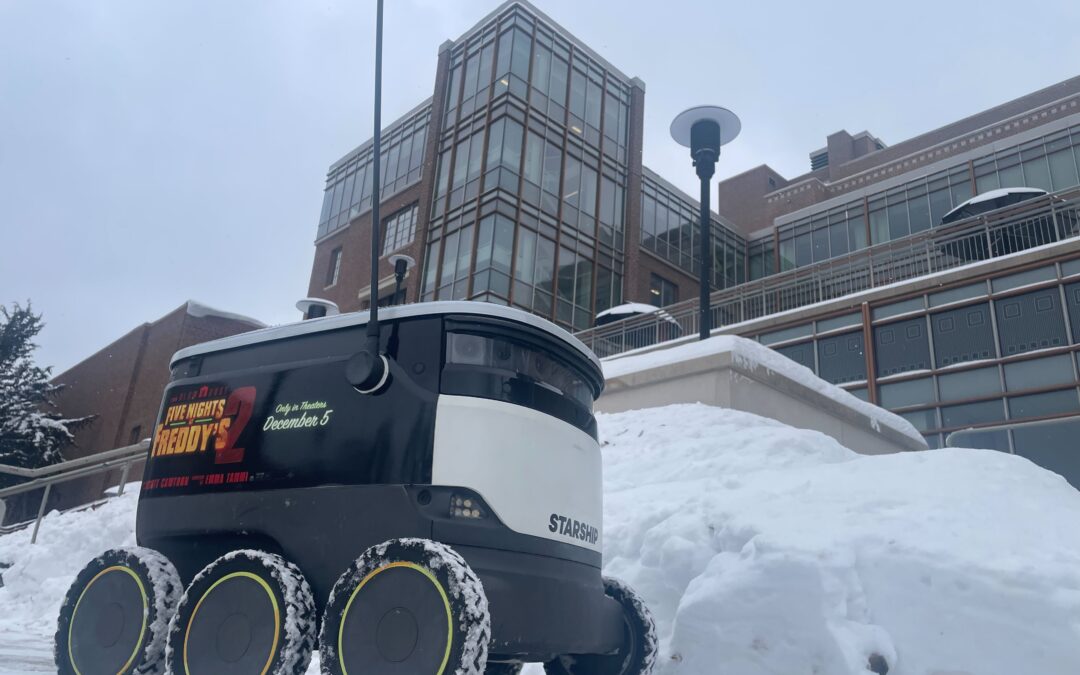
Even amid the frantic foot traffic of students during finals week and enough snowfall to make some drivers uneasy, autonomous robots with winter-ready tires navigate the University of Minnesota’s Twin Cities campus on a mission to deliver food.
Similar to the way students and staff adore a flock of turkeys that live near residential buildings, Starship Technologies robots are quickly earning a spot as campus icons.
“They’ve become part of campus culture,” said Chris Elrod, regional marketing director for Chartwells Higher Education Dining Services — the company tasked with overseeing foodservice for the Twin Cities university spanning nearly 1,400 acres with more than 56,000 enrolled students.
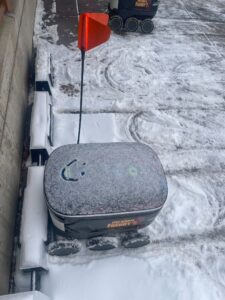
A charging Starship Technologies robot displays a smiley face drawn into a thin layer of snow covering the unit, Dec. 12, at the University of Minnesota’s Twin Cities campus.
Finals week means peak activity for the fleet of more than a dozen robots. They quietly cross bridges and cruise along sidewalks carrying orders from vendors like Starbucks and Panda Express.
Despite having just started their service at UMN a little over a year ago, most students no longer even bat an eye as the autonomous couriers coast past them on their way to deliver the cargo. During a Dec. 12 lunch rush in the home stretch of the 2025 fall semester, walkers typically just stepped out of the robots’ paths, but some smiled and watched as the machine with a flashing orange flag rolled into the distance.
Chartwells started considering a partnership with Starship for delivery services at the Twin Cities university during the spring semester of 2024. Elrod said welcoming an autonomous fleet appeared as a promising solution after the dining services provider conducted a study to determine foot traffic patterns across campus.
“What that process allowed us to do is identify some areas on campus that could potentially benefit from having food service but not enough traffic or density to support a brick and mortar full location,” Elrod said of the study. “How we answered that question is what led us to robots.”
While presenting the study’s findings to university leadership, Elrod said they were caught by surprise when a Starship robot rolled through the conference room doors, carrying menu items from Sonic Drive-In. He pitched bringing autonomous couriers and the well-known quick service brand to campus; they quickly supported the initiative.
Fourteen months after formally embarking on their mission at the UMN campus, a Sonic location is serving guests inside a busy student hub, and Elrod said the delivery robots have increased sales volumes enough to justify their presence on the foodservice team.
Starship robots currently operate at 64 college campuses, with brand plans to expand in the coming spring, according to Annie Handrick, senior partner marketing manager at Starship. Overall, the company services more than 270 locations across eight countries, surpassing 9 million total autonomous deliveries.
Even through snowy weather, the Starship fleet continues its meal-delivery mission, waiting outside popular vendors for the next order and relying on detailed campus mapping to use efficient routes to the recipient. Customers use their mobile devices to place orders and ultimately unlock the robot’s carrying compartment to retrieve their food. The autonomous unit then returns to a hotspot for its next assignment or heads to wireless charging stations near restaurants.
The robots operate 99 percent autonomously, according to Handrick. In rare situations that warrant intervention, such as unexpected construction or major obstacles, human operators step in to ensure deliveries continue smoothly.
At the UMN campus, student employees with the title of robot technician— often engineering majors — represent the backbone of the autonomous delivery operation. Ethan Andler, one such student employee, said he sees his role as a robot caretaker of sorts, diagnosing problems as needed and otherwise ensuring the fleet is up to date, clean and functioning correctly.
Andler described his duties of identifying and addressing issues with the Starship robots as a “fun challenge.”
“Something I think people wouldn’t necessarily expect about the job is the depth of these robots and the complexity of their systems,” Andler said. “It’s not just a motor, a camera and a computer; there are underlying systems and intricate parts that play a massive role in self-driving robots that can avoid people and obstacles and deliver food.”
Fittingly for their independent nature, Andler described the robots’ personality as “interesting.” He noted a couple of instances in which the autonomous couriers tried to drive away while he was cleaning or working on them.
Some of the units, Andler said, have developed reputations among their student attendants. He described one pair of robots — 6e1360 and 6e1430 — as “absolute tanks,” citing their lack of maintenance requirements.
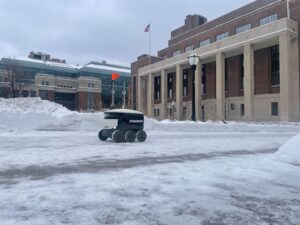
A Starship Technologies autonomous robot navigates the University of Minnesota Twin Cities campus during a Dec. 12 delivery.
Elrod said real-world, hands-on experience for student workers is just one piece of the overall benefits provided by the Starship couriers. They also drive demand to vendors, offer delivery options to parts of campus that did not previously have that option and lead to more human foodservice employees.
Campus foodservice staff initially voiced concerns that the robots would displace their positions, with some employees sharing those worries before the Minneapolis City Council. Elrod said he eased that fear by reassuring local officials that the Starship fleet would create more jobs and support existing roles rather than shrink the workforce.
“It’s meant to bring more business to retail, so we can add more positions,” Elrod said. “There weren’t delivery drivers to begin with, so we didn’t displace any jobs. If anything, we actually added more positions to be those runners who take the food to the robots. It was never about replacing jobs.”
The new runner employees receive an alert when an order is ready. Then, they collect the prepared items and load them into the robot. If more customers are ordering remotely through Starship during business rushes, Elrod said, it decreases the pressure on employees working through long lines of guests.
As of now, the Starship fleet at UMN is focused on delivery for vendors, but Elrod said Chartwells staff has explored the potential to use the robots for similar services outside dining halls, as is done at other schools. For now, though, the four-wheeled couriers will continue learning their way around campus and earning their reputation, one order at a time.
“At the end of the day, it’s not simply just about increasing revenue or driving more sales; it’s also showing the university being a leader in bringing these new and emerging technologies on campus,” Elrod said.
Note: Article Update Dec. 17 2025 to reflect updated information from Starship Technologies