Counting inventory is one of the most time-consuming and least-loved tasks for many restaurant operators, yet one of the most important.
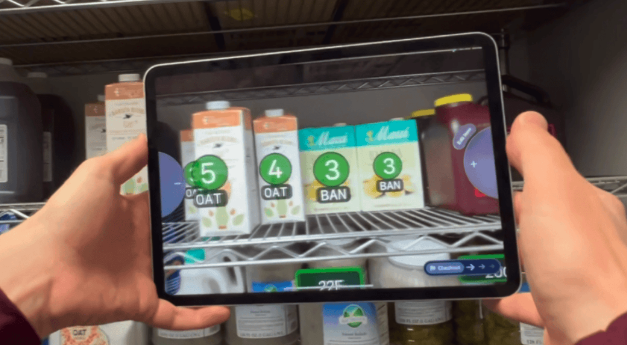
A growing wave of computer vision tools, including those from startups like NomadGo, are giving operators a way out. Using AI to scan shelves and track ingredients, these systems can take the headache out of inventory by being fast and accurate.
David Greschler, co-founder and CEO of NomadGo, said the problem has multiple dimensions that weigh on restaurants. “One is the length it takes. People are often asked to count inventory super early, before the restaurant opens, or really late at night after a long shift. Secondly, it’s filled with inaccuracy because people are either blurry-eyed or exhausted. Manually counting is just not that easy to do,” he explained.
They ran their own internal test and found that the AI system was at least 15 percentage points more accurate than manual counts. On the high end, manual inventory counting is probably only about 80 percent accurate, Greschler said.
Mistakes in counting have real economic mishaps. “If people are miscounting, it means they’ve either over-ordered, which leads to food waste, or under-ordered, which can leave customers empty-handed,” he explained.
Inside the tech
NomadGo’s system is used on iPhones or iPads. “We had to develop a technology that allows people in multiple environments to scan and not only recognize items and count…but give immediate feedback on what they’re seeing,” Greschler said.
“All the hard work, all the AI, is actually running on that device. The only reason a network is needed is to send the results, which is just a text file,” he explained.
The tech’s 3-D spatial vision system recognizes and counts items by row. For employees, the system feels like a video game.
Starbucks deployed NomadGo’s tech throughout its chain.
Related: Starbucks Brings AI-Powered Inventory Counting to Coffeehouses
“We’ve already deployed this innovation in thousands of coffeehouses,” said Deb Hall Lefevre, Starbucks’ chief technology officer, in a statement. “Inventory is now counted eight times more frequently, giving us real-time visibility and enabling faster, more precise replenishment.”
AI’s broader restaurant footprint
“Pre-COVID, restaurants were primarily analog,” Greschler said. “When the pandemic hit, operators realized, like a lot of other industries, there was a real need for digital transformation.”
NomadGo notes that digitizing inventory will soon seem as obvious as the POS revolution.
Inventory data becomes even more powerful when integrated with POS and supply systems. “POS data alone isn’t enough. Understanding what is truly on hand is key,” Greschler said.
This is especially important as employees juggle dine-in, drive-thru, and delivery orders.
But it doesn’t stop at restaurants. The technology works well for convenience stores and other foodservice industries.
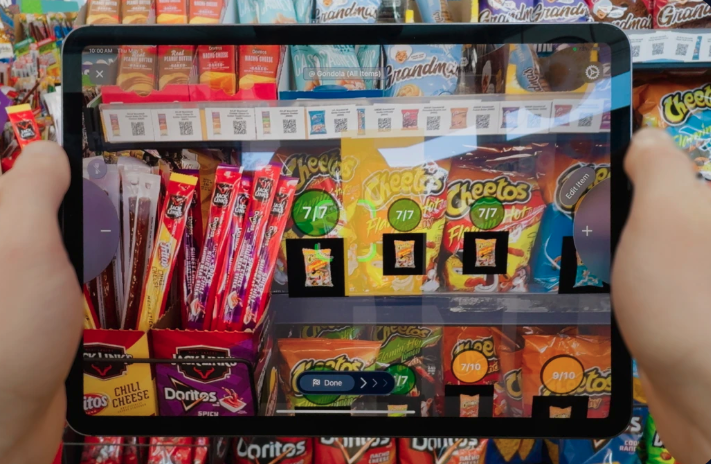
Convenience store chains could garner waste and time savings by automating inventory. Photo Credit: NomadGo
Across the industry, AI is showing up in more places, from drive-thru voice ordering to even robotics. Adoption has been uneven. Some chains have pulled back on tools like voice AI, while others are finding value.
Inventory automation has emerged as one of the most practical and widely accepted uses of AI so far.
“AI is more like a pulley that just makes things easier,” Greschler said. “Writing a proposal is easier, brainstorming is easier and counting inventory should be easier, too.”