The catering market is forecasted to exceed $81 billion in 2026 — up more than 6 percent from 2025’s valuation —, and that growth is only the tip of the iceberg as a projected 6.2 percent annual growth rate over the coming decade pushes the sector beyond $140 billion by 2035.
The changing dynamics around employer-provided meals in the workplace play a critical role in the evolving catering market. According to 2026 data from ezCater, a catering-focused third-party marketplace with more than 125,000 restaurant partners, 91 percent of orderers plan to spend as much or more on catering as they did last year, and 56 percent anticipated an increase.
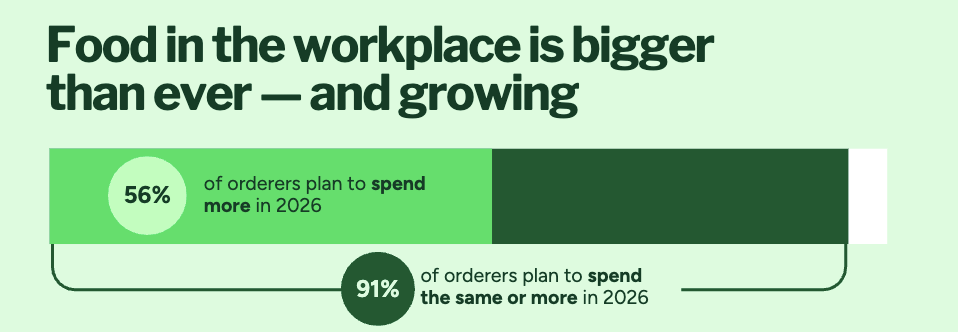
ezCater 2026 data and insights show more than half of orders plan to spend as much or more in 2026 than last year.
Catering’s role as an employee incentive seems to be heightening as the post-COVID return-to-office trend matures. Although workers have increased flexibility compared to the pre-pandemic years, only 26 percent of work locations with work-from-home-capable jobs are fully remote as of early 2026 — the lowest rate since a high of 70 percent in May 2020 — according to Gallup data.
Employee meal benefits are driving growth for catering programs and adding revenue streams for restaurants, according to ezCater data. More than half (55 percent) of employees say daily employer-provided meals make onsite work more palatable. Thirty-eight percent of employees receive such meals daily or weekly, up 26 percent from last year.
The workplace catering customer, according to ezCater, averages a check size of $430 and a headcount of 26. Thirty percent of those orders provide less than 24 hours’ notice, which requires caterers to meet short lead times. Lunch proved the most common occasion (drawing business from 90 percent of orderers), followed by dinner (59 percent), heavy appetizers (46 percent) and breakfast (36 percent).
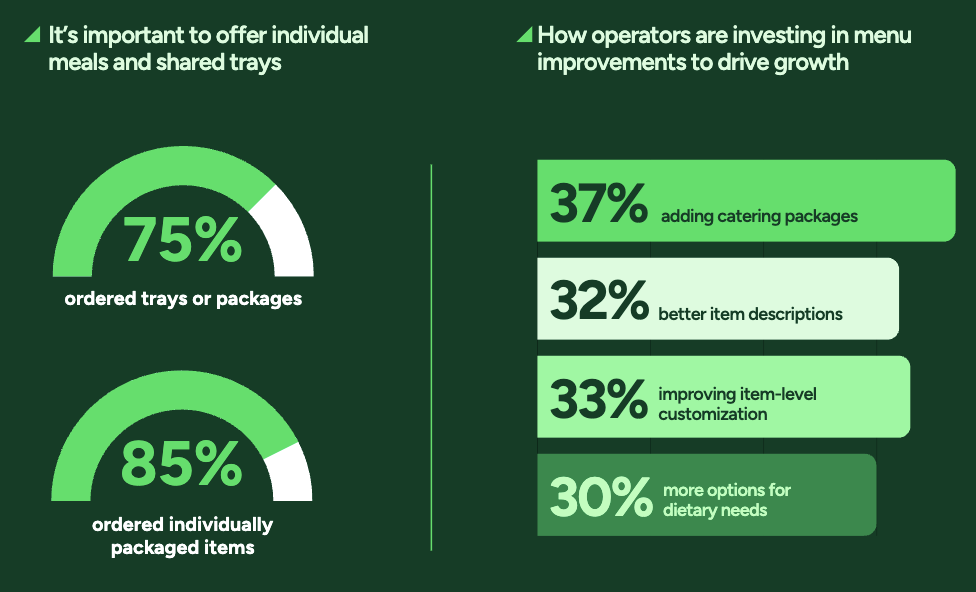
The above graphic is courtesy ezCater 2026 data and insights.
Catering customers eager to explore new options drove a key trend last year, with ezCater reporting that 96 percent of clients ordered from restaurants new to them. Orderers’ top factors when selecting menus are budgetary constraints, ease of building the right order (portion size, servings, etc.) and the presence of labels related to dietary needs (24 percent).
On the operator front, the top investment categories for menu improvements to drive growth (starting with the most common) were adding catering packages, enhancing item descriptions, improving item-level customization and adding options for dietary needs.
Order tracking is nearly a unanimous expectation among catering orderers, according to ezCater data; 94 percent of such customers expect delivery tracking via notification. Meanwhile, 50 percent of operators always provide delivery tracking on orders; 45 percent track in-house catering deliveries; and 32 percent invest in delivery management systems.
The value of catering extends beyond the initial order. Most employees (62 percent) report ordering from a restaurant in their personal lives after trying it at work, and two-thirds (67 percent) recommend a restaurant to friends and family after trying it at work.
With forecasts predicting the catering market value to jump nearly $60 billion over the coming decade, shifting expectations around workplace catering will prove crucial to how those predictions play out.