This article was originally published in Franchise Times, sister publication to Food On Demand.
Order counts were up in both delivery and carryout, the company’s aggregator partnerships with Uber Eats and DoorDash continue to bring in new customers who have been joining its loyalty program and Domino’s Pizza will introduce a new game-changing pizza product in the weeks ahead that will improve results.
Domino’s CEO Russell Weiner struck a victorious tone during the company’s second quarter earnings call July 20 as he emphasized the positive and shrugged off same-store sales that rose just 0.1 percent in the United States and declined 0.1 percent internationally.
“Same-store sales in Q2 did not meet our expectations due to a miss on ticket,” he said. “I don’t believe this miss was due to macroeconomic headwinds. Those were assumed in our plan. The miss on ticket was largely within our control, which means we can and will address it moving forward.”
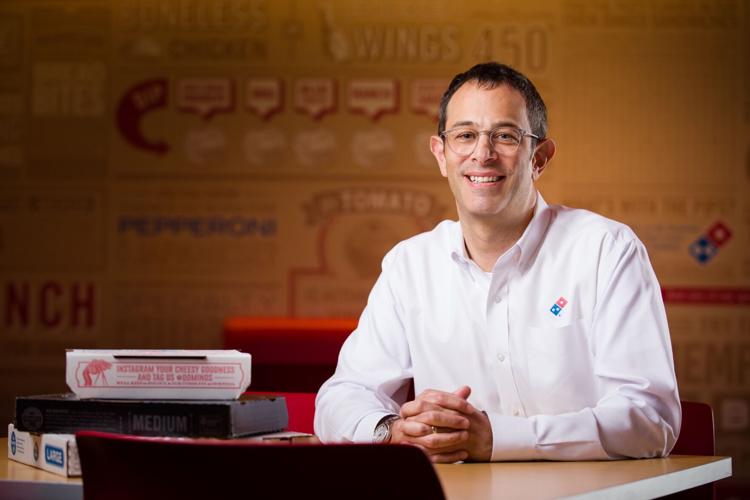
Russell Weiner will retire as CEO of Domino’s Pizza in October and become executive chairman. He says the chain will introduce “a delicious new reason to come to Domino’s” in Q3.
The miss, he indicated, was due to the launch of its premium series, including its new Slice Sauce, that did not resonate with customers as expected.
“The messaging wasn’t compelling enough,” he said, adding that messaging is already improving, the marketing calendar has been modified for the second half of the year and a new product that “will address an unmet consumer need, but this time with a pizza that is unique to Domino’s” will be introduced soon.
“This signature product will give customers a delicious new reason to come to Domino’s while protecting the core pizza occasions that have been key to our success,” he said.
Despite the same-store sales miss, Domino’s revenues for the quarter increased to $1.19 billion, up $49.3 million, or 4.3 percent, compared to the second quarter in 2025. Net income increased $135.8 million, or 3.6 percent, comparing the same periods.
“Our brand has never been stronger and our competition has never been weaker,” Weiner said. “We have the best ingredients in the business, both literally and figuratively. The scale, the team, the franchisees and an incredible new CEO in Joe Jordan.”
Jordan will replace Weiner as CEO in October and Weiner will become executive chairman. As Jordan prepares to take on the role, most of the legacy pizza competitors have lagged.
Little Caesar’s doesn’t report sales, though Technomic estimated its U.S. systemwide sales in 2025 at $4.42 billion, roughly flat with 2024. The value-based chain did open 109 domestic franchise units last year, netting an 87-store increase after closing 22 units. With six new company-owned stores, the company had a total of 4,374 total locations in the U.S.
Same-store sales for domestic units fell another 6 percent in the first quarter of 2026, the 10th straight quarterly drop. Yum Brands announced plans to close another 250 U.S. locations and then, in June, announced plans to sell the chain in two parts for $2.7 billion.
Papa Johns launched a pan pizza and oven-toasted sandwiches, and introduced a “Toy Story 5” collaboration, but in May also announced that it had closed 44 out of 300 locations identified for closure and is projecting flat to low single-digit declines in global systemwide sales and 2 to 4 percent decreases in North America.
Papa Murphy’s parent company, MTY Food Group, announced earlier this month plans to close 68 underperforming corporate-owned stores.
During the company’s second quarter earnings call earlier this month, CEO Eric Lefebvre lamented the lack of brand loyalty in the competitive U.S. market.
“The consumer will go where the pizza is the cheapest at any given time,” he said. “So, the promotional activity is super productive. But we need to protect our franchisees and their product margins. So, our teams are actively seeking more data on all the promotions we run to try to adjust them to make it as profitable as possible for franchisees.”
The next biggest player, Marco’s Pizza, had a net gain of 25 franchised locations in 2025, ending at 1,139. Franchisees opened 53, but nine were terminated, five did not get renewed and 14 ceased operations for other reasons, according to the company’s franchise disclosure document. It also has 45 company-owned locations and projected another 71 franchise openings this year.
Marco’s did get a top-tier Fund Score from market research firm Frandata, “a strong indicator of its creditworthiness and system stability,” said Edith Wiseman, Frandata’s president, in a statement.
Domino’s standing as the clear market leader right now has Jordan excited to take on the CEO role.
“Our priorities remain clear: serving customers with delicious food, outstanding value and a great experience, supporting our franchisees, and executing with discipline to drive long-term growth,” he said during the investor call.