Despite rising inflation and staffing challenges, more than nine in ten operators report that their businesses are in good or excellent standing, as digital sales continue to climb and brand leaders grow increasingly comfortable using artificial intelligence tools, according to industry polling.
Digital channels continue to thrive as revenue generators for operators in 2026, with sales through such avenues outpacing dine-in and other non-digital growth for most restaurant companies, according to August 30 data from Baird Equity Research. Among respondents in a survey of private chains, digital channels accounted for about 23 percent of total sales in August, representing a relative increase of about 22 percent from the same month a year earlier.
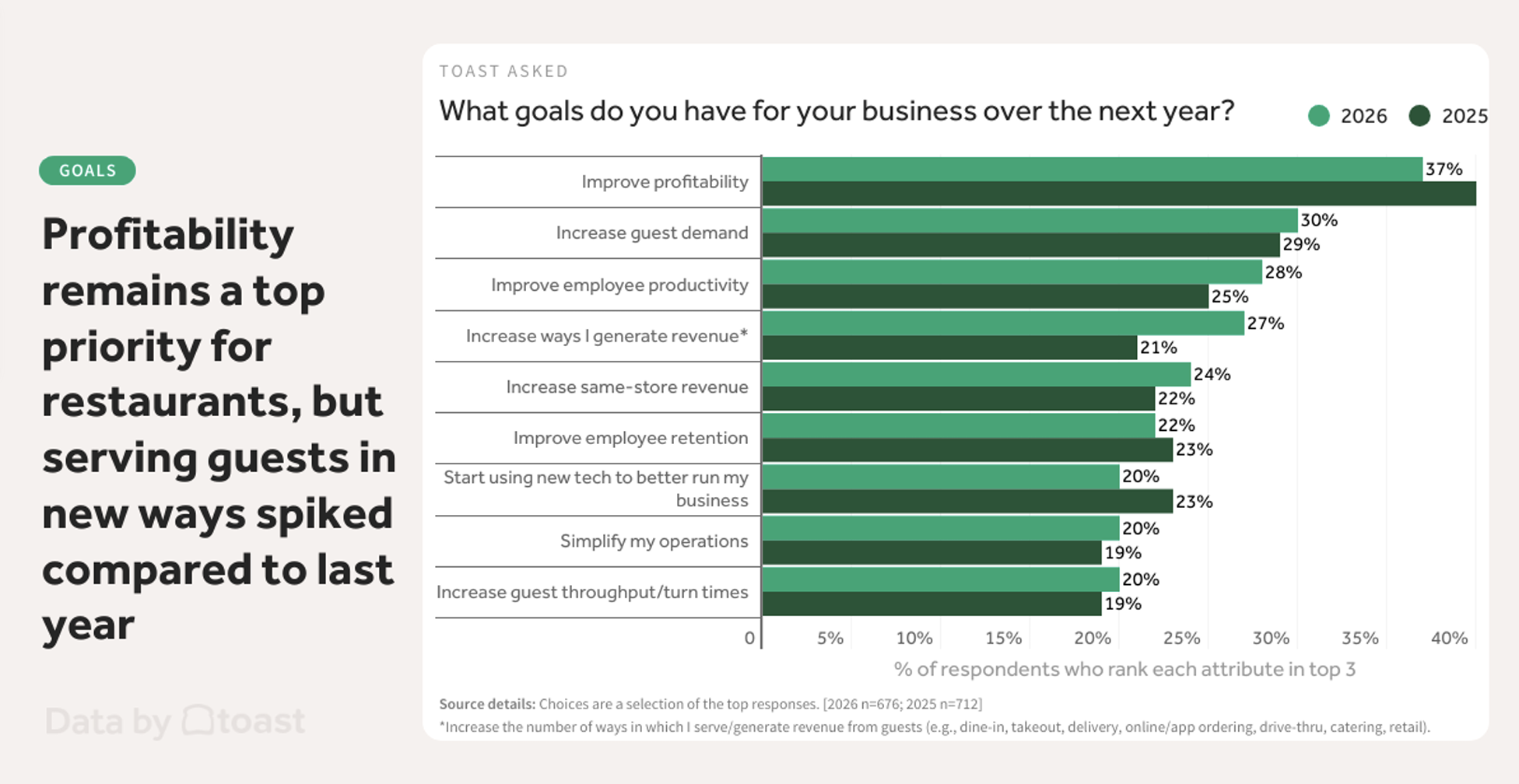
Improving profitability ranked the top business goals for restaurant operators in 2026, according to Toast’s 2026 Voice of the Restaurant Industry Survey data.
Those findings suggest a sense of durability and longevity for digital channels, a theme reflected in operators’ business goals, according to data from Toast’s 2026 Voice of the Restaurant Industry Survey. Improving profitability is the top business goal among 676 restaurant operators and decision-makers at brands with 16 or fewer locations in the United States, with 37 percent of operators ranking it in their top three priorities for the year.
Increasing guest demand was the second-most common goal among survey respondents, an objective which brands increasingly pursue through direct, often targeted, promotions to guests via digital channels such as first-party apps. Improving employee productivity rounded out the top three business objectives, which also benefits from digital channel growth, allowing in-store employees to focus on other tasks.
Digital checks average 28 percent higher than dine-in occasions, according to Baird. As a category, pizza showed the largest discrepancy between digital and in-store average check sizes, with digital checks averaging 40 percent higher, followed by fast-casual concepts (about 33 percent higher check sizes for digital orders) and coffee (roughly 7 percent higher).
Nearly half of operators plan to increase revenue by boosting guest demand, according to Toast, while 26 percent aim to do so by adding revenue streams like catering or online ordering, and 16 percent plan to focus on increasing check sizes.
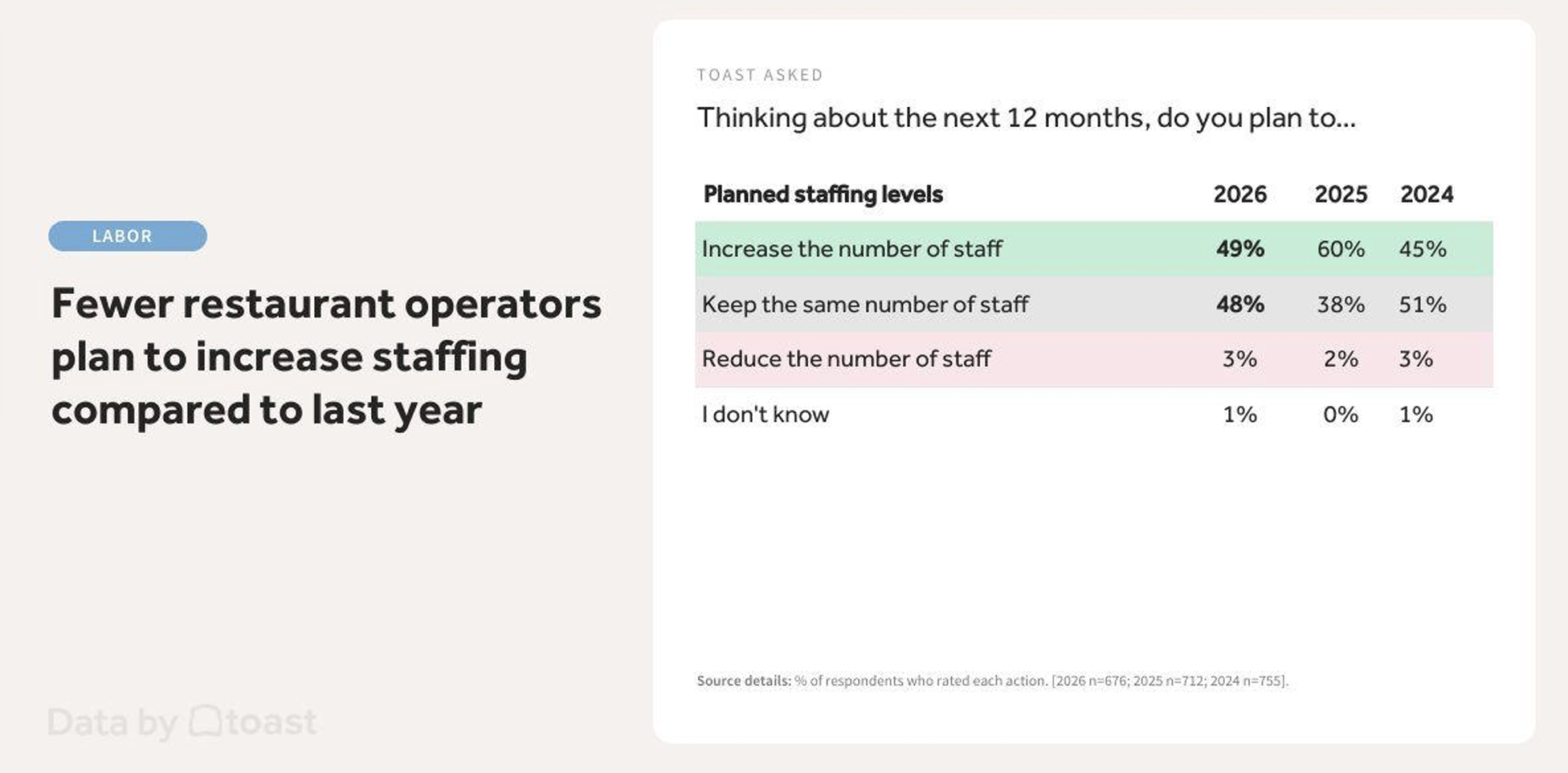
A lower percentage of restaurant operators hope to increase staff over the coming year relative to last year, according to Toast data.
Restaurant operators’ approach to AI
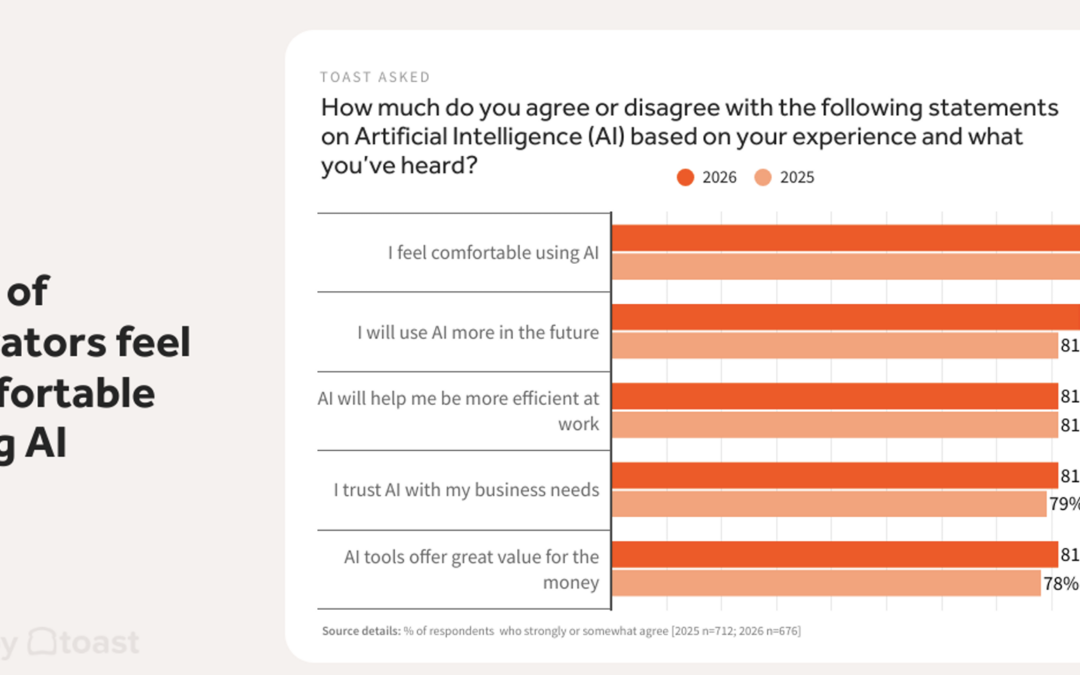
Operators are more comfortable using AI compared to last year, with 87 percent of respondents reporting greater comfort—up 1 percent. Additionally, 85 percent of restaurant leaders polled report they will use AI more in the future, a 4 percent year-over-year increase.
One key figure, 81 percent, emerged several times in Toast’s data regarding AI use among operators. That’s the proportion of respondents who believe AI will improve their work efficiency (no change from 2025); trust AI with their business needs (up 2 percent); and find AI tools offer great value for the accompanying costs (up 3 percent).
The Toast report noted 42 percent of operators are actively experimenting with AI through vendors but not on their own. A quarter of respondents are experimenting with the technology both independently and through vendors. Nearly one in five are actively exploring AI on their own without vendors—a trend more common among full-service operators (23 percent) than quick-service (16 percent). Meanwhile, 11 percent of survey participants claimed they are considering AI but haven’t started, and 2 percent are not considering using AI at all.
Tackling staffing issues
Approaches to staffing challenges are a primary focus of shifting strategies for restaurant operators in 2026 compared to last year, according to Toast’s findings.
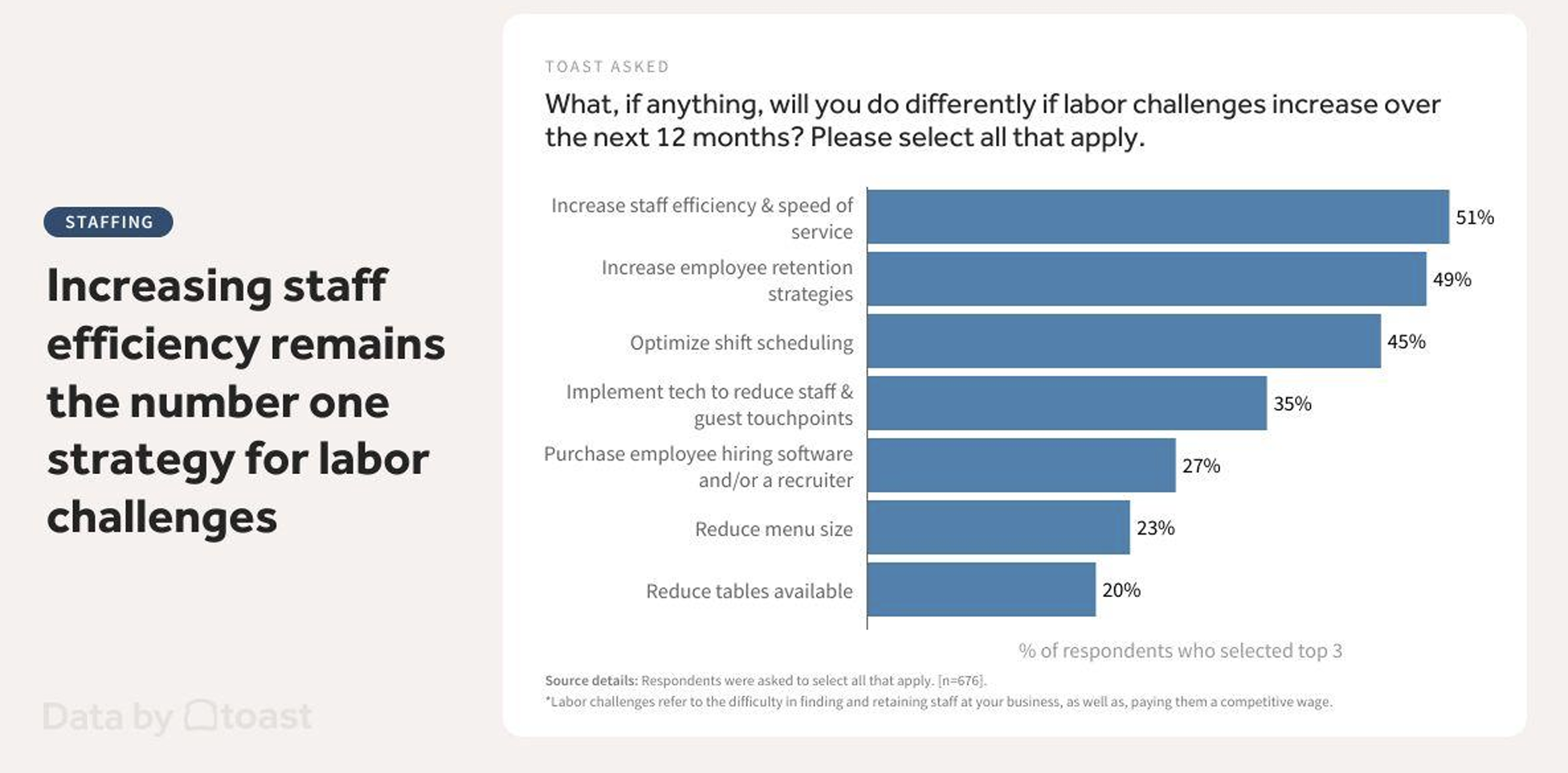
Toast survey data revealed that restaurant operators’ most frequent approach to potential labor challenge growth over the next 12 months is to increase staff efficiency and speed of service.
This year, only 49 percent of operators polled hope to increase their staff count, down 11 percent from 2025. A nearly equal number of respondents (48 percent) aim to keep their staff levels the same (up 10 percent from last year) and 3 percent are looking to reduce staff.
Among the Toast poll respondents, 51 percent of operators will increase staff efficiency and service speed if labor challenges grow. Other approaches include increasing employee retention strategies (49 percent), optimizing shift scheduling (45 percent), implementing technology to reduce staff and guest touchpoints (35 percent), and purchasing hiring software and/or a recruiter (27 percent).