Where DoorDash Labs was launched eight years ago, the mission was centered on multimodality.
Harrison Shih, the senior director of the delivery company’s technological development division, said from the start, they saw potential to expand the way DoorDash could deliver goods to people. However, during a panel at the 2026 Food on Demand Conference, he said development of new technology has to be weighed with how useful it will be to restaurateurs.
“The most important thing is determining what’s a science experiment versus something that’s actually useful,” Shih said. “I think a lot of technology companies build a product in search of a problem they can solve. You can build technology that adds friction, or you can develop technology that actually solves a problem.”
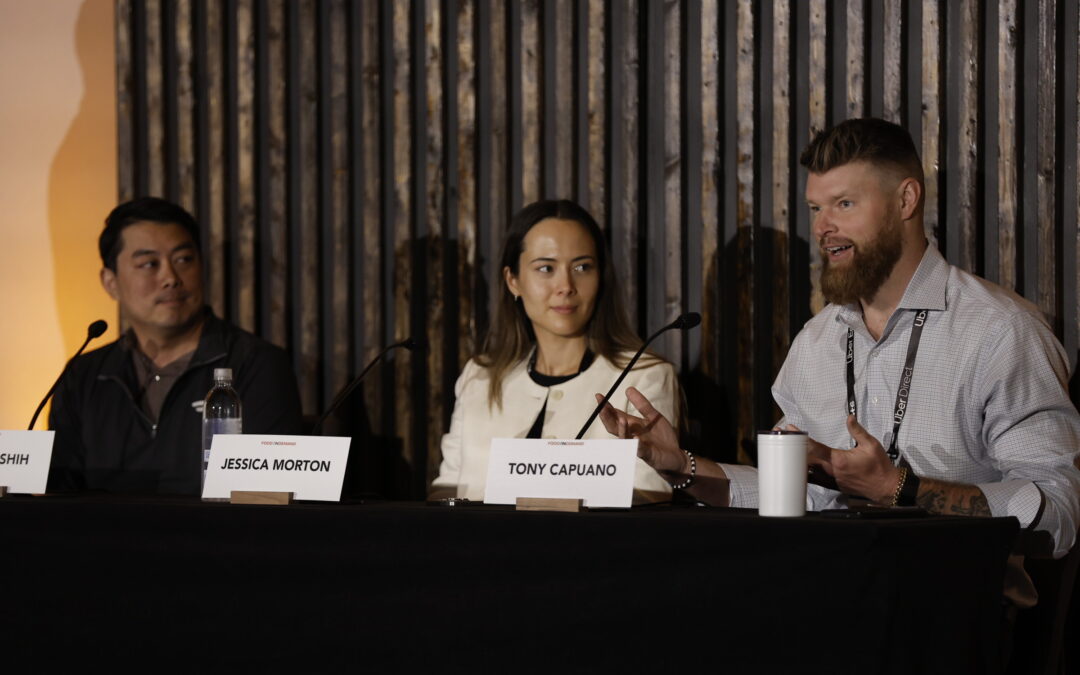
Shih was joined in the panel with Jessica Morton, the chief commercial officer for Atoms Foods, and Tony Capuano, senior vice president of franchise operations and training at Donatos Pizza. In the discussion, moderated by Atul Sood of Sood Advisory, Shih said the method at DoorDash Labs is getting a firm footing in the actual operations.
“I think that’s something we talk with our merchants all day, every day,” Shih said. “I’m very grateful to be able to do that in the position of building technology, because there are real problems out there to solve. There’s really no need to go build a bunch of really fun technology that hopefully, someday, someone will use.”
At Donatos, a brand founded in 1963 with 175 traditional units and an additional 300 non-traditional spaces, Capuano said there’s been a long tradition of improving operations and solving problems.
“For 60 years, our founder has been obsessed with reducing bottlenecks and removing friction, mostly in the operations space,” Capuano said. “We’ve had 60 years of trial and error as we test things, and our whole process is built around efficiency and consistency. What does that mean for us today? We’re utilizing rovers, automated delivery services, we’re looking into drones and we have a fully autonomous robotic restaurant in the Columbus airport.”
To increase the brand’s ability to develop new operational capabilities without disrupting the concept’s flow, Capuano said Donatos introduced the Edge Innovation Hub, where testing can take place without potential negative impacts.
“Having a safe space to test our ideas, including those ideas a little bit on the edge or outside of typical operations, is a great way to do it,” Capuano said. “We created the Edge because it allows us to think on the edge, outside of our day-to-day competencies, and it protects that.”
In Morton’s role, there are several companies under the Atoms umbrella she works with. These include robotics developer Lab37, the software company Otter, a real estate firm in ProFood Properties, and the ghost kitchen restaurant partner CloudKitchens. In her comments, she said the Donatos method of having teams be able to work semi-independently is a good strategy.
“We work with a lot of brands across many of our companies,” Morton said. “One thing I’ve seen consistently work well is when you have that brand with a huge footprint, and you have a team off to the side where their job is to find new projects, and they can move fast and are empowered to do their own thing, experimenting off to the side away from the behemoth.”
As an example, Morton cited CloudKitchens partnering with Chick-Fil-A, beginning in 2019. When the work with the chicken concept started, Morton said the brand allowed its innovation team to free reign to experiment with what worked best in a ghost kitchen setting. Today, the partnership is still going strong, and Morton said the brand is working with real estate to continue expansion.
Like Shih discussed, though, Morton said any advancement of technology solutions has to make sense inside the four walls of a restaurant.
“At CloudKitchens, we actually don’t do deals when we don’t see the numbers penciling in,” Morton said. “You can’t just say, ‘here’s a shiny new thing, let’s go for it.’ If it’s not going to work, you’re going to create more issues. Between both parties, it’s really important in the early phase that you look at the metrics and what direction they’re moving. Let’s observe what’s happening to determine whether to move forward or not.”
An example Shih shared from DoorDash Labs was its product Smart Scale. The device is a simple but effective scale designed to signal if an order is ready for delivery, or if something is missing.
“It improves the entire order flow,” Shih said. “This started as something for an experimental case, then it was brought out to 100 stores, and then it went to 10,000 in under a year. It’s encouraged us to go more in the kitchen and solve these low-hanging fruit opportunities, and we’re wiping more than 30 percent of missing items out of the orders with Smart Scale.”
Creating those efficiencies and improving the work flow for staff is a driving factor for Atoms, said Morton, who noted the labor involvement with delivery.
“One of our companies is Lab37, and we do automated food production,” Morton said. “You have 25 to 30 percent, and even 35 percent of a restaurant’s revenue is going to labor. If you can have automation and robotic solutions, that can bring down the cost and increase the frequency of those meals that the restaurants can provide to the customer.”
A product proving useful in restaurants is Lab37’s Bowl Builder, which completely automates the work in building bowl-based meals. Restaurants using the technology, according to the company, have saved 50 percent in labor spending.
For Capuano, though, it’s important for Donatos to not only focus on the numbers when determining restaurant digitization.
“I think sometimes operators, and I’m guilty of it, will look at opportunities for automation and removing friction as just a labor savings opportunity,” Capuano said. “But automating is more about being a multi-lever, saving and efficiency game that is more represented on your unit economics than just your labor line.
“The importance, for us, is getting the order accuracy right and reducing our pickup lines,’ said Capuano. “Really, what we’re talking about, is the throughput, and how we can have less waste. So, there’s multiple levers that we need to keep in mind as operators when we’re looking at implementing technology and removing friction.”
The 2026 Food on Demand Conference wrapped up Wednesday, May 7, at the Renaissance Addison Dallas Hotel.