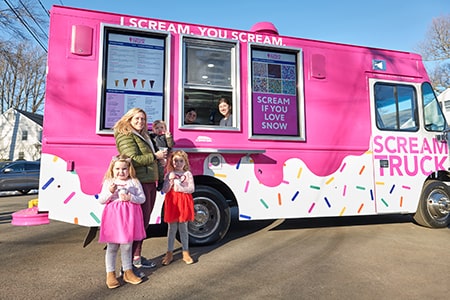
The ice cream truck experience has been the same since the 1950s. A truck wheels into a neighborhood. Kids spot the truck. Kids lose their minds. It’s like Santa Claus on wheels. Eric Murphy loves that as much as anyone. But he has reimagined something a little different. With his model, the excitement builds not with the first sight of the truck but the first sight of a text. And the target isn’t kids but moms.
 “We have 125,000 registered households on our platform,” the founder and CEO of Scream Truck said in an interview, “and 90 percent of them are families in residential homes. Moms ordering for their kids are our core demographic.”
Murphy’s idea reflects our post-pandemic times. Instead of a truck arriving in a neighborhood unannounced, Scream Truck operators text members ahead of time asking if they’d like ice cream. “We create the demand,” Murphy said. It doesn’t make cones without an order prepaid. And then it heads toward the customers, with music, not jingles, playing.
Murphy launched Scream Truck in New Jersey in the fall of 2020, right at the time when consumers were hungry for off-premises offerings. He obviously couldn’t have foreseen something like a pandemic — he had been incubating the idea for years — but lockdown turned out not to be a bad time to try his idea, which he describes as similar to Goldbelly. “It’s a unique offer of a premium product that you can’t just get at a grocery store or through DoorDash or Uber Eats,” he said.
Murphy named the concept Scream Truck as he envisioned consumers screaming when the truck arrived. He launched the first truck in Westfield, New Jersey, and the plan was to divide the city into neighborhoods and text residents for each hour of service.
“The beauty of it is if you don’t get your quota for that hour after texting two or three neighborhoods, you can just text another neighborhood until you get to the 10 or 12 stops you need,” he said, noting that he aims for 40 customers served per hour. “The majority of the time we’re able to fill our routes completely.”
Convenience is one thing. Taste is another. Murphy knew early not to skimp on flavor.
“We have about 60 different toppings, including Ghiradelli sauces and sprinkles and cookies and candies, so that consumers can build their own items,” he said. “We just did a partnership with Levain Bakery, which is a well-known cookie company in New York. We use premium ingredients.”
it also offers the trucks for events, which are sold in time blocks. “They are booked online, similar to Open Table. Customers can do 30 minutes, an hour, an hour and a half, two hours. Ninety percent of our events are booked online without us having to go back and forth. We don’t negotiate on price per person and all the things that most food trucks do for catering. We give a maximum number of customers that we can serve in a time window and then we show up. There’s no back and forth with phone calls or emails. People love the convenience of that.”
App-based loyalty spurs demand
The company deploys a web app bult with proprietary software that manages the orders and includes a loyalty offering. It has an iOS app for all of its trucks. An operator is guided through a daily navigation that is simple to follow.
“They just log into the app, see their schedule for the day, click navigate, and it takes them to their first route or event. It’s all turn-by-turn directions. Everything is automated. So when they get to house number three, the software sends a text to the next house saying we’re almost there. A driver just needs to click a few buttons every stop.”
Today the company has 16 trucks serving 175 New Jersey towns. Murphy has 50 people on the payroll and expects to bring in just under $4 million in revenue for the year. He and his business partner, Jason Black, who serves as president of the brand, have raised about $7 million to fund growth. They are planning another fundraising round in the next few weeks. Murphy is not timid about his ambitions.
“We’re piloting a pizza truck with the same concept right now and are in talks with a couple possible partners for tacos,” he said. “The vision for the next 10 years is to become a $100 million company with a billion-dollar valuation.”
Data matters
That valuation he anticipates will not simply be based on revenues but the quality of its data.
“We’re getting first-hand data from our customers every day,” he said. “We know what kind of house they live in, how many kids they have, if they have a dog or a cat. We have all this information to create great experiences for a multitude of brands.”
And the concept is proving portable. Scream Truck recently signed a deal to roll wheels in Las Vegas through a partnership with Lou Tobin, a former partner in Tao Group Hospitality and the co-owner of Lotus of Siam in Red Rock Resort. Plans call for the launch of 10 to 15 trucks in Sin City by the end of 2026.
The fundraising round to come will be pivotal in supporting the brand’s new franchising model. Last year it announced a first franchisee in Monmouth County, New Jersey, and it is actively courting more, for a liquid capital requirement of $300,000 and a franchisee fee of $35,000.
“Over the next 12 to 18 months, we anticipate getting at least 25 new franchisee commitments,” Murphy said. “Each of those franchisees could have multiple trucks. We’d like to have 1,000 trucks in operation by 2032.”
That would be a lot of sprinkles.