Editor’s Note: This article is part of our Summer Series, where Food On Demand explores a different topic each month. July’s focus is beverages.
From mixing cocktails to pulling espresso shots, robots are taking on a growing role behind the bar.
According to Market Research Future, the robotic bartender market will grow from nearly $1.8 billion in 2025 to $8.6 billion by 2035, while Business Research Insights projects the global robot barista market will expand from $1.27 billion in 2026 to $3.73 billion by 2035.
“The upward push of robotics and synthetic intelligence (AI) has revolutionized the food and beverage zone,” Business Research Insights stated.
Labor shortages are one driver, but operators are also investing in automation to improve consistency, speed drink preparation and create interactive moments. That’s especially true at events, one of the fastest-growing use cases for the technology.
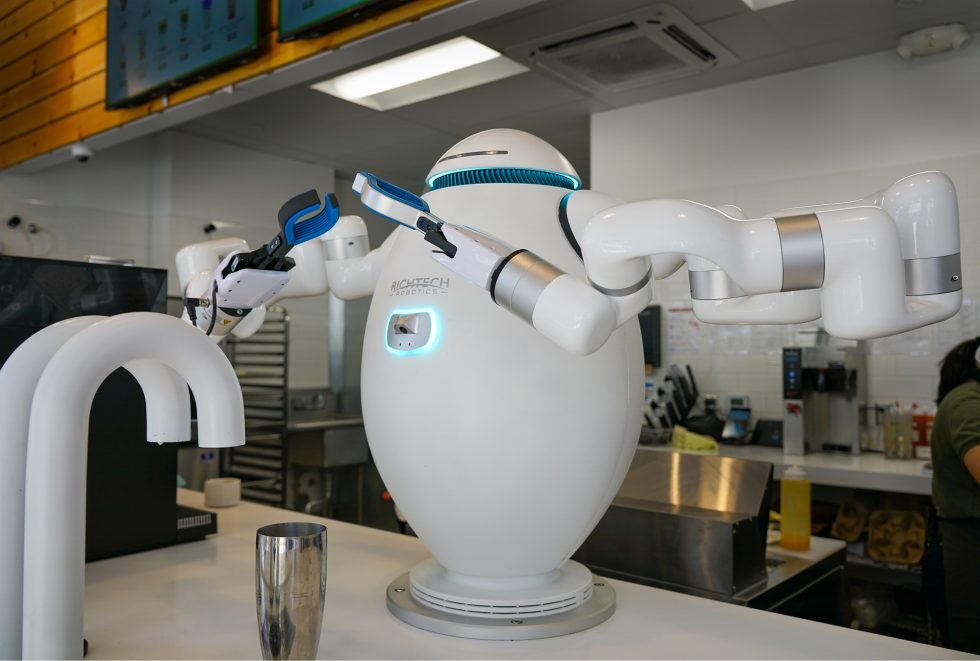
RichTech Robotics developed a duel arm robotic barista and bartender, ‘ADAM’.
One company working in both spaces is Richtech Robotics. Its dual-arm robot ADAM first gained attention as a robotic barista before expanding into alcohol.
“A lot of businesses have already invested in nice $20,000 espresso machines from Italy,” said Timothy Tanksley, director of marketing for Richtech Robotics, during a previous interview at the National Restaurant Association Show. “We wanted to make sure we’re meeting them where they are, so we designed a system that features equipment commonly found in cafes, including a precision grinder, distribution and tamping equipment, and a hand-pressed espresso machine. ADAM is no longer constrained to an API-enabled coffee machine.”
Using Nvidia-powered artificial intelligence, ADAM monitors the espresso extraction process and makes adjustments to improve consistency.
ADAM has also expanded into stadiums. The robot was installed at Globe Life Field, home of the Texas Rangers, where it serves beer and cocktails. According to the company, the installation generated more than $32,000 in revenue during its first 30 days. ADAM has since expanded to venues including the T-Mobile Arena in Las Vegas.
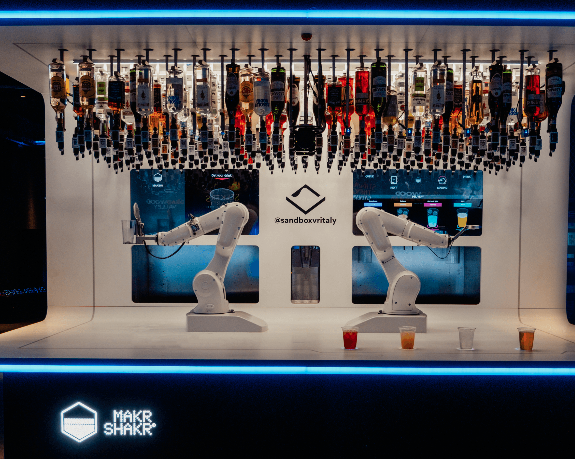
Makr Shakr developed ‘Toni’, which uses dual robotic arms to prepare cocktails ordered through a touchscreen
Makr Shakr is taking a similar approach with robotic bartending. The company’s Toni system uses dual robotic arms to prepare cocktails and has served more than 4.5 million drinks since launching commercially in 2017. One of its deployments is at the Portal Lounge inside Minneapolis-Saint Paul International Airport, where Toni prepares cocktails ordered through a touchscreen. Between orders, Toni even breaks into a dance for travelers.
Other formats work well for events and venues that don’t need a traditional bar setup.
Rotender, for example, resembles an automated vending machine more than a traditional bar. The system can prepare shots and cocktails in less than 30 seconds using a rotating carousel that holds up to 16 one-liter bottles. According to the company, each unit can make up to 350 drinks before needing to be restocked.
Customers select their drink, pay and watch as the machine spins, lights up with LED displays and prepares the beverage. Rotender also includes age verification technology that matches a customer’s identification with facial recognition.
Rotender founder and CEO Ben Winston said the concept is designed for high-traffic environments where guests are looking for a quick drink.
“High balls like vodka, soda, whiskey, ginger, these are the most popular liquor-based drinks that customers are ordering when they go out to these really high-volume events,” Winston said during a previous interview.
The next evolution looks a little different. Earlier this year, Makr Shakr introduced Robi, a humanoid bartender developed with Politecnico di Torino. According to the company, Robi is designed for hospitality environments where it can prepare and serve drinks while interacting with guests. Makr Shakr says the robot is trained using virtual reality-assisted teleoperation, allowing a human operator to guide its movements before it gradually learns to perform those tasks on its own.
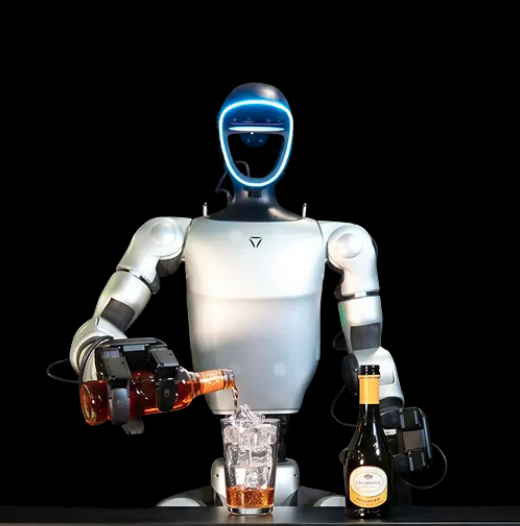
Makr Shakr introduced ‘Robi’, a humanoid bartender developed with Politecnico di Torino.
Whether pouring espresso, mixing cocktails or entertaining guests between orders, beverage robots are showing up more and more in hospitality.