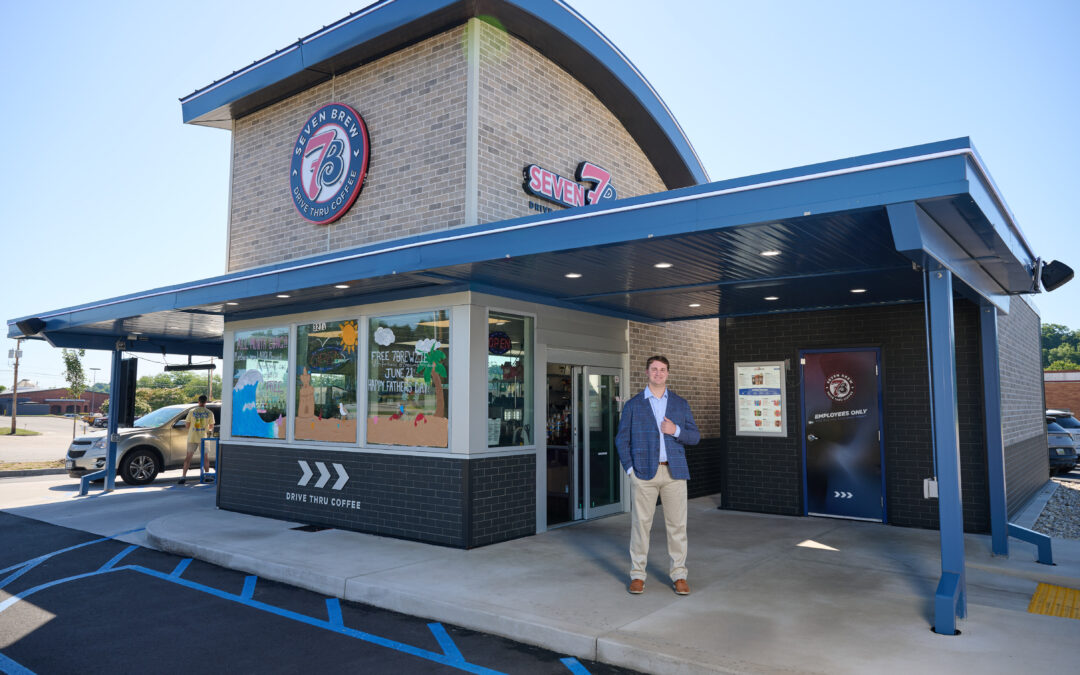
Note: A version of this story was originally published on Franchise Times, a sibling publication of Food On Demand. Accompanying photos by Adley Haywood.
As the playlist rockets from the Spice Girls to Bruno Mars, with shots of Queen, Taylor Swift and Drake mixed in, a dozen employees—or “Brewistas,” as 7 Brew prefers to call them—assemble drinks with names such as Trickshot Lemonade, Pink Mermaid 7 Fizz Soda and Cereal Milk Matcha for the conveyor belt of customers rolling through the double drive-thru.
They do it without missing a beat. And occasionally, they even serve coffee.
Such is the scene at 9:30 a.m. on a Thursday in June in Danville, Virginia, where six months earlier Brew Crew Holdings brought specialty beverage sensation 7 Brew to the city of 42,000 people. Cars line up when the shop opens at 5:30 a.m., says Matt Martinkovic, one of nine operations directors at Brew Crew, and the customer traffic doesn’t stop until closing time, which at this location is 10 p.m. Sunday through Thursday and 11 p.m. on Friday and Saturday.
“The fast-food spots next to us stay open until midnight, so even the nights here are busy,” notes Martinkovic, who is responsible for a “pod” of stores in Virginia and Tennessee. The weekly volumes are “insane,” he says, and when bottlenecks form—be it in line as employees take orders on tablets, or at the shot stations as drinks are built in more than 20,000 combinations—a specially trained “slayer” steps in to help reset the rhythm.
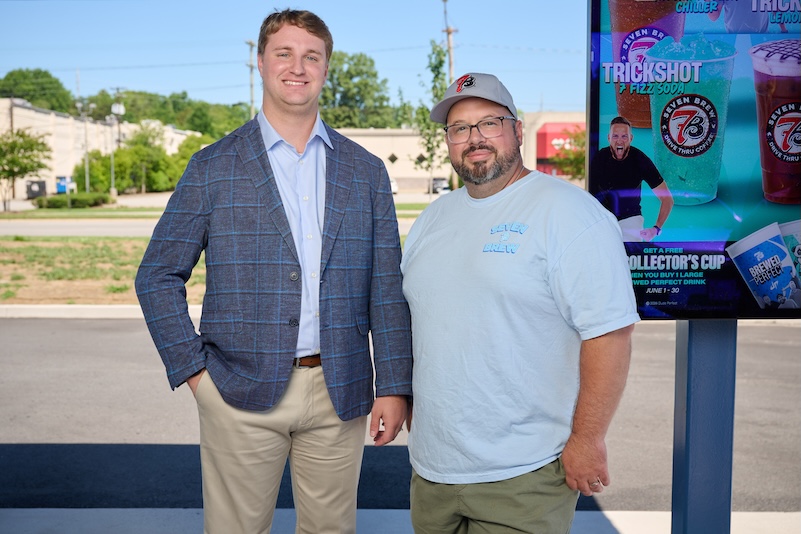
Connor Wilson, left, convinced his former high school principal, Matt Martinkovic, to join Brew Crew. Now a director of operations, Martinkovic is responsible for nearly a dozen stores.
(Photo by Adley Haywood)
While the words “drive-thru coffee” appear on the store signage, 7 Brew’s appeal isn’t in a typical hot cup of joe. It’s the lattes, energy drinks, smoothies, teas and sodas, which are customizable, brightly colored and primed for social media sharing. They’re also mainly served cold.
“I think the industry hasn’t been disrupted in a long time, and that’s what’s been happening over the last few years,” says Brew Crew President Connor Wilson.
7 Brew had just eight corporate locations in 2020 and now is closing in on 1,000. It, along with the likes of Dutch Bros and dirty soda concepts Swig and Fiiz Drinks, is pushing more traditional coffee players and quick-service restaurants to reconsider their beverage offerings. With the help of refreshers and cold brews, iced drinks overtook hot coffee sales at Dunkin’ two years ago. The refresher platform at Starbucks is a $2 billion business, and McDonald’s is adding a variety of options such as a mango pineapple refresher and Red Bull Dragonberry Energizer as it chases the drink boom.
Are we anywhere close to hitting peak beverage? “It’s really an impossible answer at this point,” says Wilson. “We’re just trying to create our fair share in the marketplace for ourselves.”
Brew Crew is churning out locations as quick as it can. The company debuted on the Franchise Times Restaurant 200 ranking of the biggest restaurant franchisees last year when it did $126 million in sales from 72 7 Brews in 2024. The Vestal, New York-based group ended 2025 with 130 stores and revenue of $273 million.
After selling 26 units in January to fellow franchisee Southern Brew and opening 23 stores so far in 2026, Brew Crew had 127 stores as of June 5 and was slated to open 14 more by August 1. The third and fourth quarters will be even busier, Wilson says, as the group aims to open 100 locations on the year.
“We love where the brand’s headed,” he continues. “We know there’s a lot more white space and a lot more growth that we can obtain.”
Selling customer service
Wilson was a newly minted graduate of Binghamton University in New York who thought he’d go down the investment banking route when his dad, longtime restaurant operator and co-founder of CoreLife Eatery Larry Wilson, sent him to Fayetteville, Arkansas, to check out what at the time was a seven-unit brand he’d heard about from local resident and former Planet Fitness franchisee Brandon Sebald.
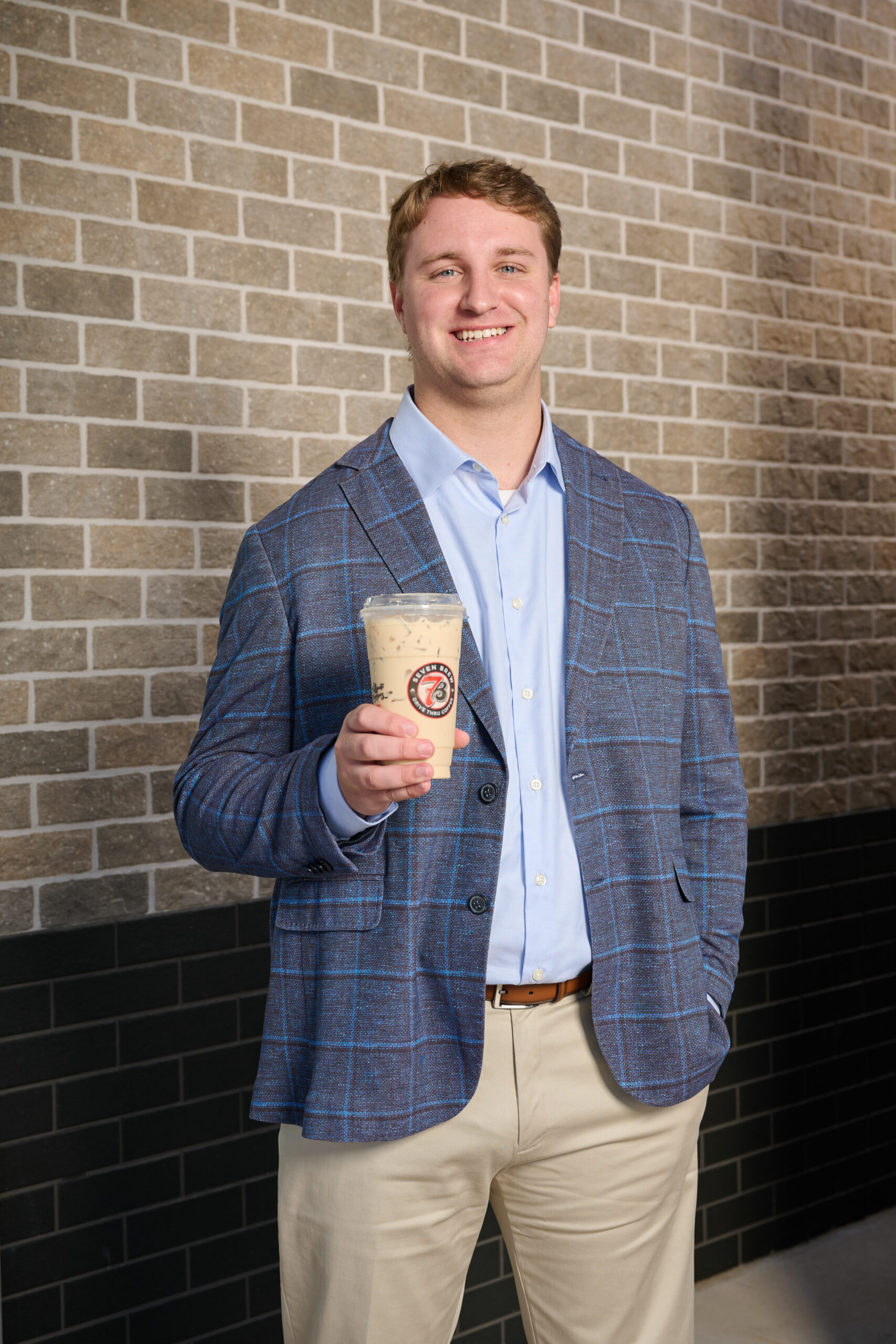
Connor Wilson, president of large 7 Brew franchisee Brew Crew, says the beverage segment “hasn’t been disrupted in a long time,” and 7 Brew is doing just that.
(Photo by Adley Haywood)
“I remember the first thing I called my dad and said was, ‘I’ve never seen employees so happy at 6 in the morning,” says the 28-year-old Wilson, who also owns four Jersey Mike’s. “I’ve never seen so much energy, so much vibrance from people, especially at 6 a.m., working.”
That was in spring 2021, and within six months they and Sebald formed Brew Crew, signed the original 45-unit agreement and opened the first franchised 7 Brew, in Springfield, Missouri. Today, the group’s territories stretch across 10 states—Indiana, Kentucky, Louisiana, Mississippi, Missouri, New York, Ohio, Pennsylvania, Virginia and West Virginia—with development rights in four more states.
Expansion, Wilson says, starts with an ability to secure real estate. His team, which includes Director of Real Estate Travis Odom, continues working to educate landlords and commercial property developers on why 7 Brew is an ideal tenant.
“They’re wanting to have more of a conversation than they were two years ago with us,” when 7 Brew wasn’t yet on the national radar, says Odom, who joined Brew Crew in 2023 and also still operates five Moe’s Southwest Grill units in Pennsylvania.
Odom’s site selection motto is “where traffic meets convenience,” and with the Wilson family’s backing and an experienced team, the company is able to move quickly once it identifies a viable location.
“I think that really helps us, because obviously landlords want revenue as soon as they can get it, so the quicker we can get there, the better. And quite honestly, for us, we want to go fast, too,” he says.
Another asset is 7 Brew’s modular buildings. The prefabricated units, at 510 square feet, fit into different types of real estate where a typical restaurant wouldn’t. But sites still need anywhere from 8,000 to 50,000 square feet to accommodate the drive-thru lanes, according to the brand’s franchise disclosure document, which usually means the outparcel to a shopping center.
Before it opens a store, Brew Crew spends weeks training employees and then holds several giveaway events, which do double duty as a marketing tactic and to fine-tune operations.
“It’s a lot of repetition. And when we notice drinks are not correct, we throw them out,” says Wilson. “Our costs of goods sold are a little higher in the beginning, but it allows us to make sure we’re giving the customers exactly what they’re looking for.”
It’s also a time for the operations directors and store managers to emphasize the importance of the experience and the interactions with customers. Beyond the trendy beverages, Wilson continues, people come to 7 Brew because the brand cultivates kindness.
“It’s almost like we’re selling customer service and giving away drinks,” he says.
Brew Crew maintains a strict hiring process, and looks for employees who bring energy and positivity. Candidates are interviewed in groups, “to see how they interact together,” Wilson adds.
“We can teach virtually anyone to make coffee and make drinks and all these things, but it’s really hard to teach someone to have a real relationship and connection with someone they just met.”
Positioned to accelerate
Wilson acknowledges the goal of building 100 units this year is “lofty,” but says the company prepared for the push more than a year ago by bolstering its in-house development team. Earlier this year it completed a transaction with Fifth Third Bank for $260 million of senior secured credit facilities, and it’s finalizing the creation of a property company to pair with its operating company.
The aforementioned sale of 26 stores in Tennessee to Altamont Capital-backed Southern Brew (part of Tacala, the largest Taco Bell franchisee in the country), meanwhile, was another financing play.
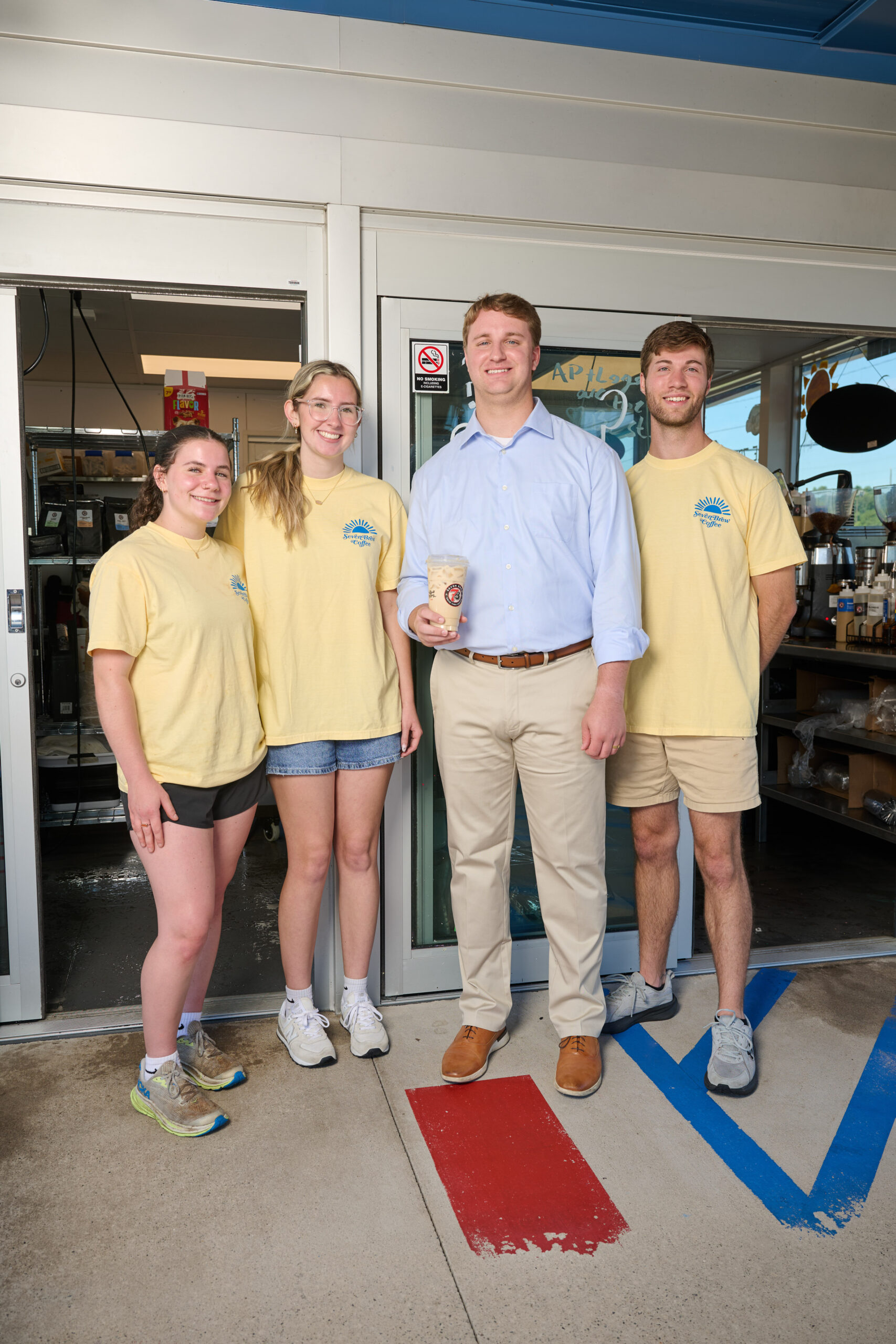
Brew Crew—and 7 Brew generally—looks for employees who embrace the brand’s energy and positivity, and can bring it to customers, says Connor Wilson, second from right, with staff in Danville, Virginia.
(Photo by Adley Haywood)
“We needed to work with the banks to put some multiples out there. Every time I worked with a bank, they’re like, ‘Well, we don’t know what the resale value is,’ so we were really trying to focus on helping the banks figure out what are these things worth in the open market,” Wilson explains. “We can really use that with our lenders to say, all right, now we know what a transaction is worth. Here’s how you can evaluate it on your credit side, so we can open up more capacity.”
Eye-popping expansion
There was no 7 Brew at the outset of 2017. Co-founder Ron Crume opened the first location, in Rogers, Arkansas, in February of that year.
The concept quickly generated a strong customer base, and a group of entrepreneurs formed parent company Brew Culture and bought 7 Brew in January 2020, when CEO John Davidson came on board. In 2021, the then-nine-unit company started franchising and attracted a new majority owner in Drink House Holdings, an investment partnership created by Jimmy John Liautaud, the founder of the Jimmy John’s sandwich, and Lone Star Steak House founder Jamie Coulter.
Drink House exited in 2024 as private equity giant Blackstone, which also owns Jersey Mike’s and Tropical Smoothie Cafe, came in with a growth investment. The brand hired Chris Dawson, who was leading Walk-On’s Sports Bistreaux, as its president in July 2024 and added Nick Chavez, who was chief marketing officer at KFC U.S., as CMO later that year.
Other notable hires in the last two years include Chief Technology Officer Danyel Bischof-Forsyth, who came from Tyson Foods, and Chief Supply Chain Officer Christopher Held, who held that same role at Inspire Brands.
7 Brew has the leadership and infrastructure in place to support rapid growth, notes Wilson, and other franchisees are leading the charge alongside Brew Crew. Between 2021 and 2025, franchisees opened 578 locations. Another 437 franchises were slated for this year.
The chain’s modular buildings cost $310,000 to $600,000 before freight and installation, and the total investment, assuming a 10-unit commitment, ranges from $940,500 to $2.3 million. That’s against an average unit volume for franchised stores of $2.65 million in 2025, an increase from $1.9 million the prior year.
7 Brew franchisees operate under a tiered royalty structure, where units doing less than $20,000 in weekly sales pay 4.5 percent of revenues as royalties. Those that make from $20,000 to $25,000 pay 5.5 percent, and units generating more than $25,000 per week pay 7 percent.
The brand targeted—and has been able to attract—large and sophisticated operators, including several Taco Bell groups that each have more than 300 locations of the QSR Mexican brand.
MIC Glen, Tacala and Anchor Point Management closed 2025 with 65, 38 and 37 7 Brews, respectively, with many more in their pipelines. The brand also proved compelling enough to draw mega-franchisee Greg Flynn, whose Flynn Group last fall signed on to develop 160 units.
“7 Brew’s unprecedented growth acceleration is directly attributed to our strategic focus on empowering exceptional franchise partners,” Dawson told Franchise Times late last year. “We’ve built our expansion around identifying and partnering with dedicated franchisees who share our vision to cultivate kindness and joy with every drink, through our service, speed, quality, energy and atmosphere.”
Even with all the growth and the attention it’s drawing from within the restaurant industry, “there’s still a lot of people that don’t know what 7 Brew is,” says Wilson.
But if Brew Crew has anything to say about it, more people soon will, he continues. “The culture, the atmosphere, the energy; you’ve never seen anything like it in another restaurant brand.”
Brew Crew Bulks Up
Leadership: CEO Larry Wilson, President Connor Wilson, CFO Richter Yeske; Director of Real Estate Travis Odom
Up 66 spots: Brew Crew is No. 61 on the Franchise Times Restaurant 200 ranking of the largest restaurant franchisees in the United States, jumping up from No. 127. The company finished 2025 with 130 7 Brew units that did $273 million in sales.
Unit count: After selling 26 locations in January to fellow franchisee Southern Brew and opening 23 units so far in 2026, Brew Crew had 127 stores as of June 5. It was slated to open 14 more by August 1.
Early entry: Larry Wilson and Brandon Sebald formed Brew Crew in 2021 and opened the very first 7 Brew franchise, in Springfield, Missouri. That opening, in December 2021, came just three months after they signed the initial agreement.
7 Brew’s Meteoric Rise
8: Founded in 2017; ended 2020 with 8 corporate units.
13: Started franchising in 2021. Ended that year with 13 units (1 franchise, 12 corporate).
40: Jumped to 40 units at the end of 2022.
180: Nearly quintupled in size, to 180 units, in 2023 as franchising takes off.
321: With 136 new franchise units and 5 more corporate stores, 7 Brew rockets to 321 locations in 2024.
604*: Franchisees opened as many locations in 2025—281—as the brand did the previous two years combined, to end the year with 604 units.
777: 7 Brew celebrated the opening of its 777th location, in San Antonio, June 10.
1,051: With 437 projected franchise openings and 10 new corporate stores planned, 7 Brew is slated to reach 1,051 locations at the end of 2026.
* Total includes two nontraditional units without drive-thrus.
Source: 7 Brew franchise disclosure documents