This article was originally published in Franchise Times, a sibling publication to Food On Demand
Most pizza franchises emphasize three operational aspects: ordering, food preparation in the kitchen and delivery.
In all three phases of the pizza game, brands large and small are getting more high tech, from incorporating artificial intelligence in ordering assistance, to deploying robotics in the kitchen and even automating delivery. The ramp up has been especially noticeable in the last five years, with Domino’s and Marco’s Pizza both testing driverless delivery vehicles, in 2021 and 2023.
More recently, Little Caesars entered the delivery bot fray. In August 2025, Little Caesars announced a partnership with Serve Robotics to begin robotic deliveries in certain areas of Los Angeles. Orders are placed through the Uber Eats app, and the autonomous sidewalk robots—which can move at speeds of up to 7 miles per hour—deliver pizzas within 20 to 30 minutes.
Kevin King, president and CEO of Donatos Pizza, said his brand is considering similar technology, noting that it’s something not far off for the category and that it will change the pizza delivery experience “dramatically.”
“I can’t tell you what the exact timeline is,” King said. “But I will tell you it is the future. Is that in the next two, five or 10 years? I don’t really know, but I know the cost of doing it is coming way down. Today, there’s still a number of barriers, but I think the drones are on the horizon.”
More of a focus for King is on the here and now, though, as the brand is looking to continue the mission of its founder Jim Grote through digitization.
“He was always interested in making pizza more consistent,” King said. “So, when we think about automation and equipment and even our systems and processes, we always start with ‘how do I make pizza exactly the same every time.’ Automation is big in doing that, because the precision you get with automation is always better.”
In the back of the house, one example for Donatos is the Smart Saucer, equipment able to sauce a pizza in about seven seconds. The concept is also known for its pizzas with exactly 100 pepperoni slices, and its team also developed a machine that slices pepperoni right into the spot on a pie.
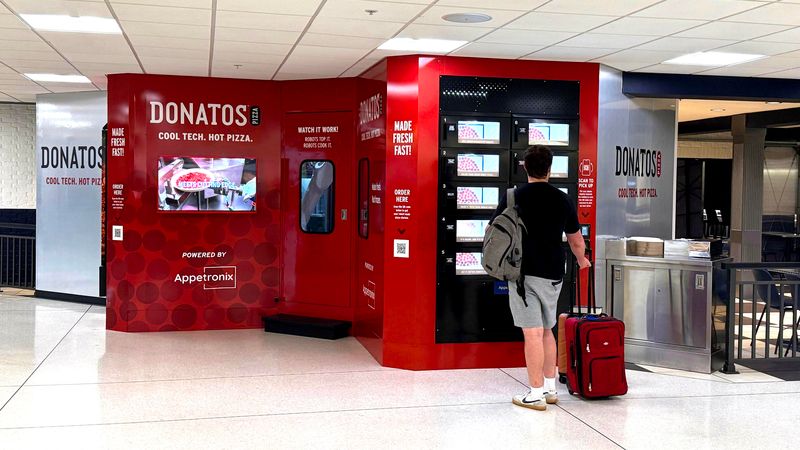
Donatos, which has 180 locations, rolled out a fully automated store in the Columbus, Ohio, airport last June.
“It’s not about eliminating people, it’s about giving the guest a more consistent product,” King said. “We have it in our company restaurants and some of our franchised locations. We’re looking at other aspects in the kitchen, too. We’re also looking to how we can automate managerial functions so we can give our people better information in the kitchen.”
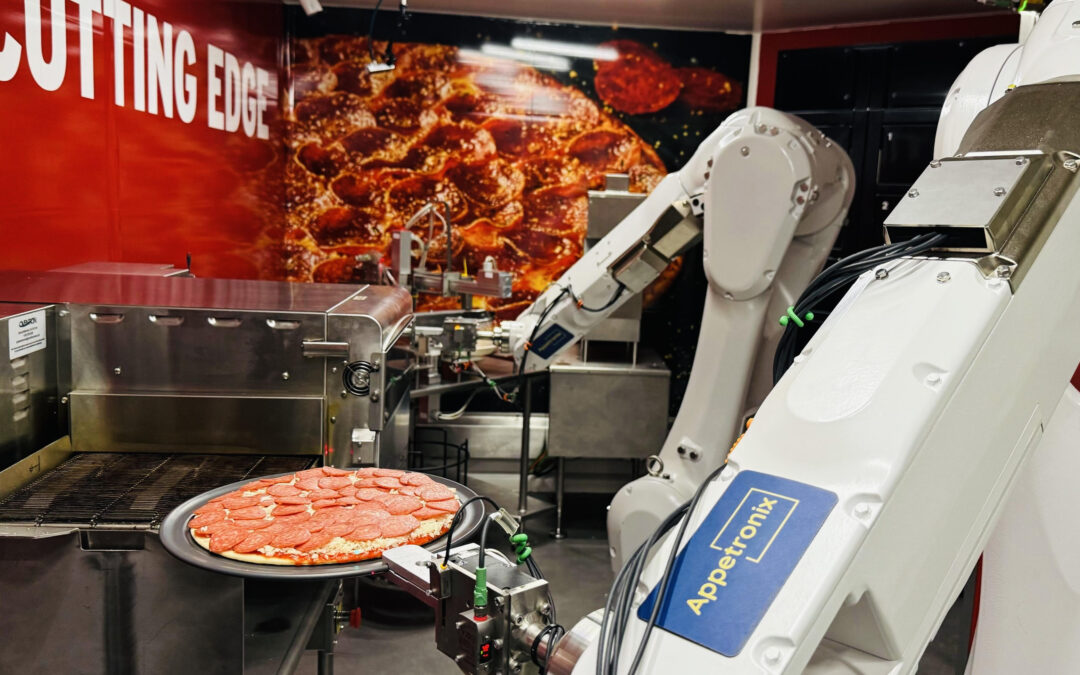
Donatos, which has 180 locations, also rolled out a fully automated store in the Columbus, Ohio, airport. The equipment is able to sauce, add cheese, bake and cut a 10-inch pizza in about six minutes.
Pizza Guys, a California-based franchise founded and led by Shahpour Nejad, is also testing robotics in its stores. Nejad said they’ve developed a robot that can apply the sauce and another that can spread the dough.
“It’s not fully there yet, but if we don’t give it a chance, it’s never going to improve,” Nejad said. “So, we tested it, gave feedback on how it needs to be faster and more accurate than a human because if it’s not, it’s not going to work. It has to be better and consistent, plus there’s also the cost and maintenance of it. So, we’re still in testing for those purposes.”
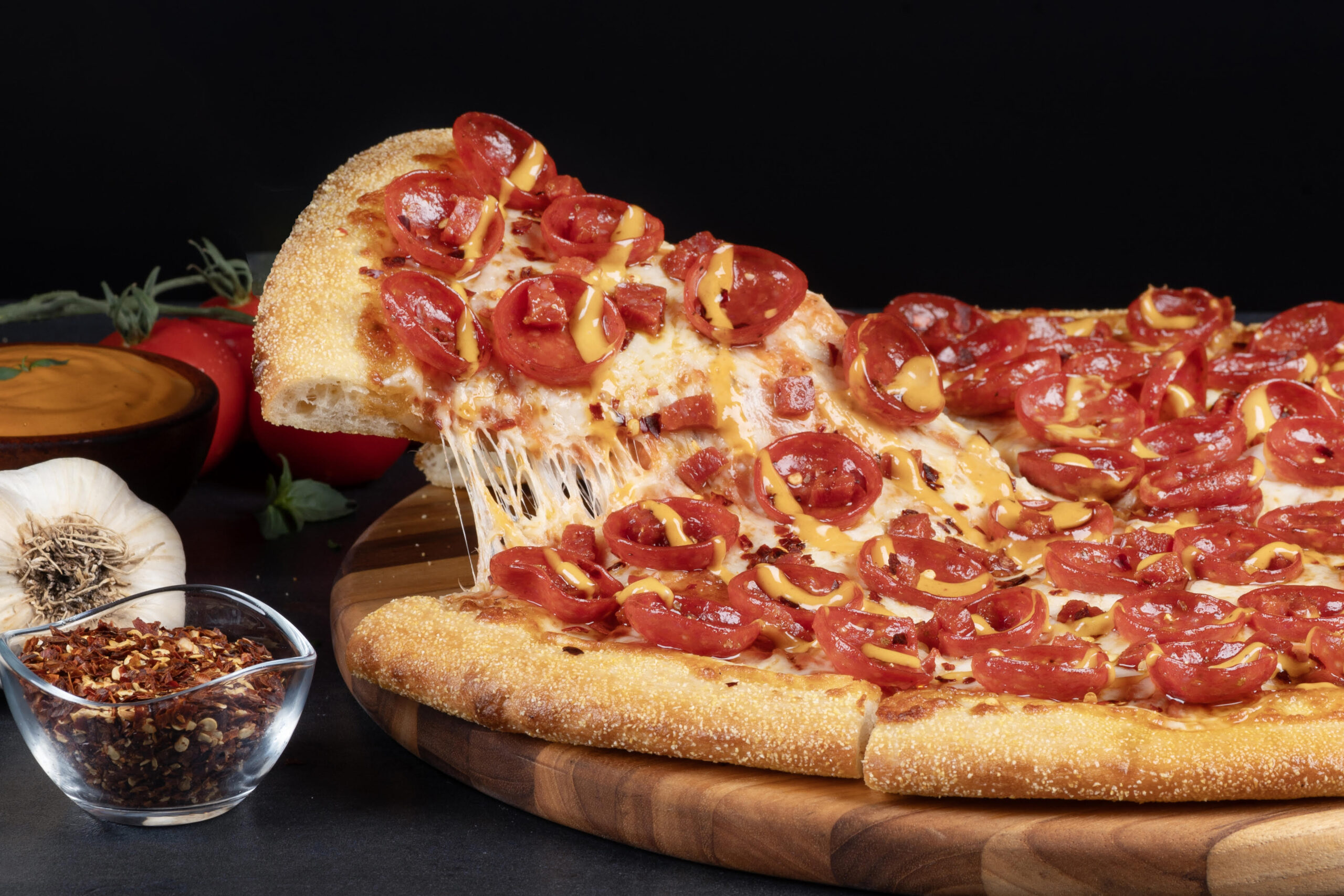
Pizza Guys, like other brands, is digitizing its ordering and testing ways to integrate robotics.
Pizza Hut, meanwhile, has put its technological focus on kitchen efficiency through digitization of training and employee coordination. In a statement to Franchise Times, the brand said it has worked with parent company Yum Brands to implement its AI-driven Byte by Yum system to help train its workers.
“We’ve implemented Byte Kitchen & Fleet, which unifies kitchen operations and delivery management in real time,” Pizza Hut said. “This technology optimizes order routing, delivery, and food preparation flow. For example, the AI will determine when a delivery should be made and who should deliver the pizza based on location, time of day and other metrics.”
Another component of the Byte technology is a digital restaurant coach, which provides employees the ability to flag operational issues and suggest next best possible actions and on-the-job guidance. The brand also noted it was piloting AI ordering and launching additional call centers to reduce in-restaurant workloads.
Pizza Hut, which has more than 6,000 domestic locations and another 13,000-plus international units, might have a new owner before too long. Yum announced in November it was initiating a “formal review of strategic options” for the brand, which could include a sale as the brand continues to see closures and declines in same-store sales.
In search of easier ordering
Advances in the ordering process have been widespread in the category, too, with major concepts making moves. In January, Papa Johns updated its digital ordering capacity through a partnership with Google Cloud’s newly expanded food ordering agent AI platform.
The system lends its services across all its channels, and includes a function to automatically apply best value combinations. The program also has an advanced voice and group ordering function for multi-person orders.
In April 2025, Domino’s entered into a new partnership with DoorDash. The move followed the company’s shift away from its exclusive partnership with Uber Eats, though the brand still uses that platform. With the DoorDash connection, users can order from a local Domino’s on the app, and the GPS tracking system for the pizza delivery process is fully integrated.
Pizza Guys, which recently surpassed 100 units, has worked to incorporate AI phone answering, which is now in the final testing phases. Nejad said it has helped staff tremendously at the store level, as have improvements made to the brand’s online ordering platform.
“You have to create platforms that are easy for the customer to navigate,” Nejad said. “Pizzas can be made 1,000 different ways, and that was the biggest challenge for us originally in getting our online ordering system corrected.”
To ensure those orders are made accurately in the kitchen, Nejad said the company’s point-of-sale system is also connected to a digital visual aid in the kitchen. He said it provides workers a real-time guide on what the order is, and how many portions to use, creating more efficiency versus relying on memory or having to constantly consult charts. Nejad said it’s been especially helpful with complex orders.
In its ordering system, King said Donatos utilizes both first- and third-party delivery options. The orders come in, King said, mostly through an AI call center or online. Like other brands, the technology applies to the kitchen and those carrying the food.
“The tools we see today route the driver and communicates directly to the guest on where the pizza is, and also summons drivers from third-party platforms when it gets busy,” King said. “We’re looking at what’s next as far as where the delivery system goes and how we can do better. We’re always looking at what’s next on the technology side and how to take advantage of it. Our approach is how do we give the guests a better experience.”
“I think in today’s era, if you’re not with technology in your restaurants, you’re going to fall behind and fall short,” Nejad said. “You need to not only concentrate on the food quality, but the technology has to be there, too, because that’s what the customers are demanding.”