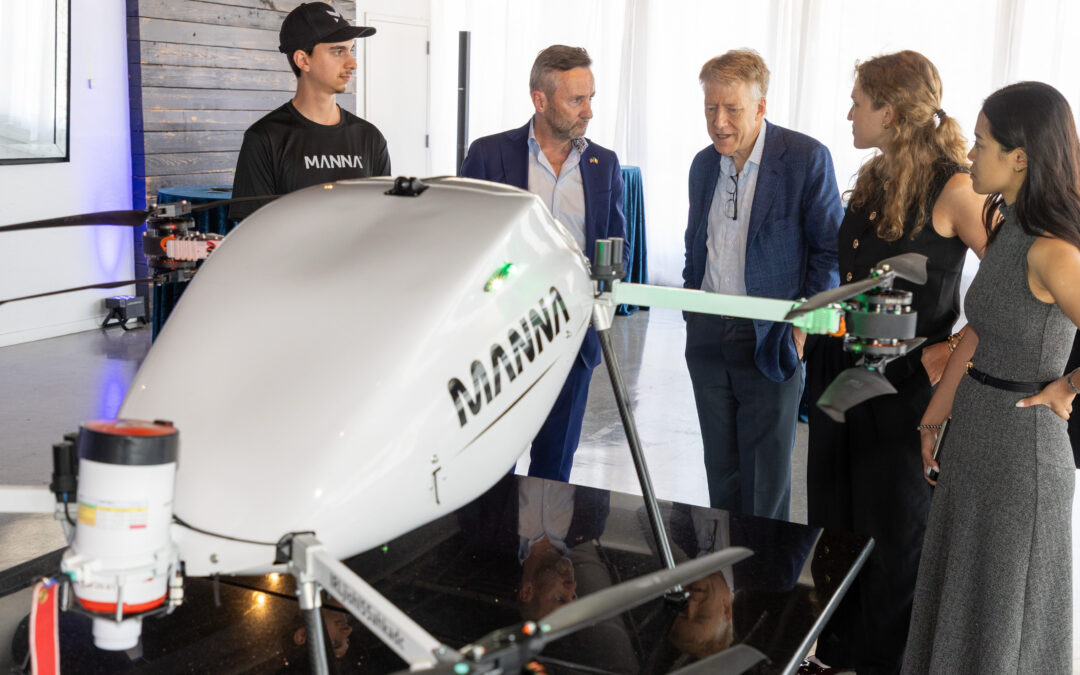
Irish drone delivery company Manna is pivoting its growth strategy midair this summer, halting operations in its home country in June and instead narrowing its focus on scaling its United States presence from its new operational base in Tulsa, Oklahoma.
Manna announced the launch of its first full-scale metropolitan U.S. operation in early July, cementing Tulsa as its major entry point into the national market after rolling out services in the Dallas-Fort Worth area nearly three years ago.

Bobby Healy, CEO of Manna
Bobby Healy, CEO of the drone company with about 380,000 global deliveries since 2018, said the initiatives in Tulsa will fuel Manna’s broader U.S. expansion in coming years. He noted the efforts coincide with critical regulatory changes and “all the signs you need to know that the industry has now hit the start of the hockey stick.”
Manna intends to service roughly 90 percent of homes in Tulsa within a year. The firm aims to build its U.S. manufacturing base in the northeastern Oklahoma city, bringing more than 1,000 jobs over the next three years across manufacturing, maintenance, and business functions; commercial operations; aviation and flight operations; and customer support.
“We’ve always been dreaming about the U.S. market,” Healy said, previously citing a lack of a clear national policy framework for commercial drone delivery as a reason for pausing Ireland operations. “We’ve always been wondering when’s the right time to go. And the key change that happened was there was an executive order 12 months ago from the White House to really lean into this space and to require state bodies like the FAA to get behind this and make it happen.”
The order — which requires the Federal Aviation Administration to fast-track rulemaking for beyond-visual-line-of-sight drone operations — alongside EO 14305, a similarly focused mandate also issued June 5, 2025, specifically aim to promote unmanned aircraft system manufacturing, increase commercial drone use and expand national security applications for drones in U.S. airspace.
According to an August 2025 analysis from the law firm Greenberg Traurig, the pair of executive orders add restrictions on foreign drones in both the government and commercial sectors while supporting domestic drone technology efforts.
Why Manna landed in Tulsa
With its sights set on U.S. expansion, Manna selected Tulsa — a city with no major drone delivery operations despite a friendly regulatory environment and years of investment in its autonomous systems ecosystem.
Healy said the choice boiled down to the community offering the most suitable spot for the company’s U.S. manufacturing base.
“We spoke to [potential partners in] a number of different states, and we had a lot of inbound from different states to bring our jobs, to bring our HQ there. And Oklahoma, in particular, has a very strong aerospace sector, a very strong aerospace manufacturing sector, a huge amount of local talent, a very, very strong governor that wants to bring jobs to Oklahoma, a superb set up with the city and the partnership they have with the George Kaiser Family Foundation.” Healy said, listing reasons Tulsa proved the “obvious” choice for Manna.
Tulsa’s lack of any major drone delivery companies wasn’t a major factor in this decision, though Healy said the lack of a co-inhabitant of the airspace did provide some benefits.
“We’re signing up partners all over Tulsa at the moment, and if somebody comes to Tulsa later, we’ll already be there in the parking lot working with that restaurant, that family business or whatever it is,” Healy said, noting that there is enough demand for autonomous aerial delivery to stave off competition-centered worries.
Healy said Manna drones were already flying through Tulsa airspace as of late July, with plans to fully launch commercial services in September. Local officials, including Oklahoma Gov. Kevin Stitt, touted the move as displaying the state’s embrace of such tech-focused operations.
“This is exactly what it looks like when Oklahoma competes and wins. Manna could have chosen anywhere in the country, and they chose Tulsa because we’ve built a business climate that supports innovation, rewards investment, and moves at the speed of industry,” Stitt said in a July 8 press release. “This investment means more than 1,000 good-paying jobs for Oklahomans; it puts our state at the forefront of the future of aviation and drone technology.”
The existing drone autonomous system groundwork predating Manna’s arrival in Tulsa includes more than $250 million in public and private funding, according to a July 19 release from tech-focused economic development organization Tulsa Innovation Labs. Those investments bolstered infrastructure, workforce and commercialization avenues to support the drone industry and autonomous delivery sector as a whole.
Manna’s global headquarters will remain in Ireland, where the company intends to continue investments in research, engineering, manufacturing, product development, regulatory affairs and commercial operations.
Manna’s operational model
When comparing Manna’s operational model to major players in the drone delivery space, Healy said the firm’s approach more closely resembles Alphabet’s Wing than Zipline’s hub-and-spoke fulfillment system.
“We will partner with what we call high-throughput locations, meaning that we’ll go to a strip mall or a big brand restaurant that will do 50-100 deliveries a day,” Healy said. “Our [setup] infrastructure is a $100 rubber mat from Amazon, but we put in our charging rack there [at partner restaurants and retailers]. That charging rack obviously has to be temperature controlled and indoors. It’s low cost for us, so we can spin up one of these things in a few days. It’s a very low-cost operation in terms of capex investment.”
Those high-throughput locations include shopping malls, showcasing Manna’s strategy to work alongside on-demand delivery platforms like DoorDash to transport restaurant orders as well as a variety of other use cases, Healy said.
“We’re not competing with the aggregators; we’re partnering with them,” Healy said, adding Manna partnered with Deliveroo, DoorDash and Just Eat Takeaway.com in Ireland. “We think that’s a more sensible strategy is to partner with those guys and fit into them.”